Адрес
304 Северный кардинал
Улица Дорчестер Сентер, MA 02124

Рабочие часы
Понедельник - пятница: 7AM - 7PM
Выходные: 10AM - 5PM
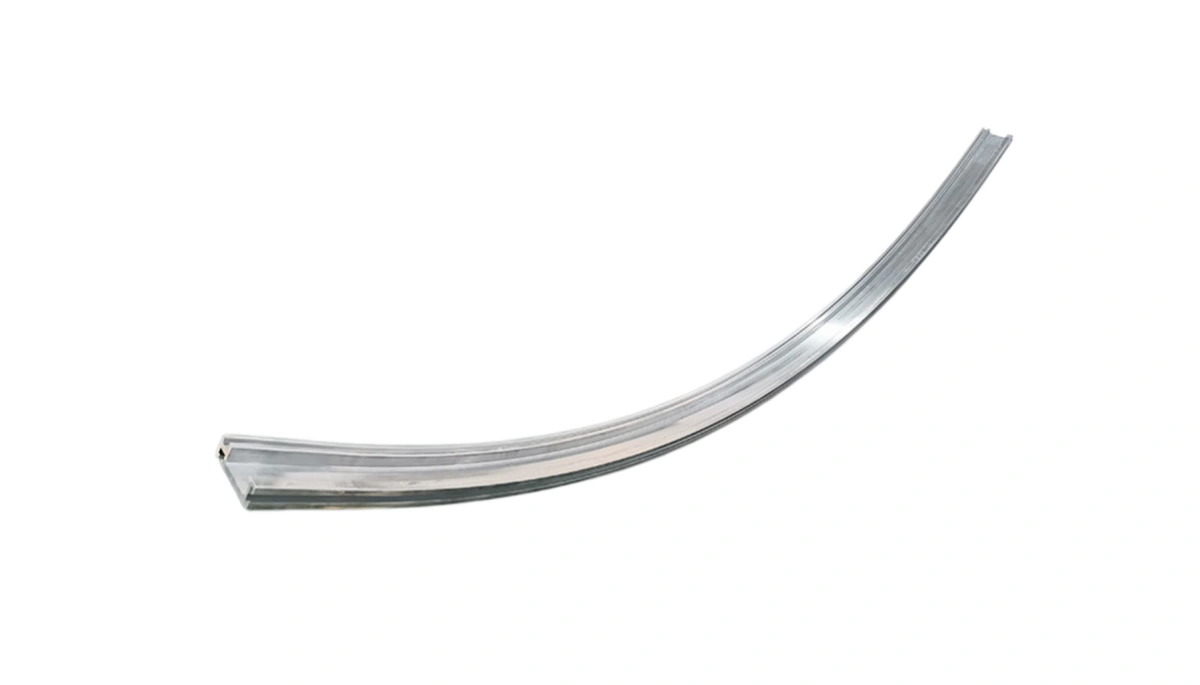
Демонстрация контактной формы

The Ultimate Guide to Aluminum Profile Stretch Bending: Mastering Tension, Temperature, and Springback Compensation

Introduction: The Evolution of Aluminum Profile Stretch Bending

In the modern manufacturing landscape, the demand for lightweight, high-strength structural components has skyrocketed. From the aerodynamic curves of high-speed trains and aerospace frames to the sleek architectural facades of skyscrapers, aluminum profile stretch bending has become an indispensable technology.

Unlike traditional press bending, aluminum profile stretch bending involves applying a precise tensile force to an aluminum extrusion while simultaneously wrapping it around a die. This dual-action process minimizes structural defects, reduces wrinkling, and allows for complex curvatures that other methods cannot achieve. However, achieving high precision requires a mastery of three critical pillars: Tension Control, Temperature Regulation, and Springback Compensation.

This guide provides an in-depth analysis of the technical parameters and advanced strategies required to optimize the aluminum profile stretch bending process for high-performance applications.


I. Precision Tension Control: The Engine of Plastic Deformation

Tension is the heart of the aluminum profile stretch bending process. Its primary role is to ensure that the material transitions from its elastic state into a controlled plastic state, allowing it to take the shape of the mold without structural failure.

1. Pre-tension: Eliminating Initial Slack

Before the actual bending begins, a pre-tensioning force is applied. This stage is crucial for “setting” the profile and ensuring it is perfectly aligned with the die surface.

  • Parameter Setting: Typically, pre-tension is set between 50% and 70% of the material’s yield strength.
  • Case Study: For the widely used 6061-T6 aluminum alloy, which has a yield strength of approximately 200MPa, the pre-tension stress should be strictly controlled within the 100–140MPa range.
  • SEO Insight: Precise pre-tensioning reduces the risk of “waviness” in the inner radius of the bend, a common defect in low-quality aluminum fabrication.

2. Bending Stretch (The Wrapping Phase)

During the bending phase, the material undergoes the most significant deformation. The “stretch ratio” determines the final integrity of the profile.

  • Optimal Range: The stretch amount should be maintained between 1% and 3%.
  • The Physics: This specific range optimizes the stress distribution across the cross-section. If the stretch exceeds 3%, you risk wall thinning or catastrophic fracture. If it is below 1%, the material remains too close to its elastic limit, resulting in uncontrollable springback.

3. Post-bending Pull: Stabilizing the Molecular Structure

Once the profile has reached its target curvature, a final “supplementary pull” or post-tension is applied.

  • Recommended Value: 0.2% to 1.0% of additional elongation.
  • Benefit: This stage acts as a mechanical stress-relief process. It evens out the residual stresses generated during bending, locking the aluminum atoms into their new configuration and significantly improving dimensional stability.

Technical Pro-Tip: Modern CNC stretch bending machines utilize servo-controlled hydraulic systems to allow for multi-stage loading, ensuring that the tension profile matches the specific geometry of the part.
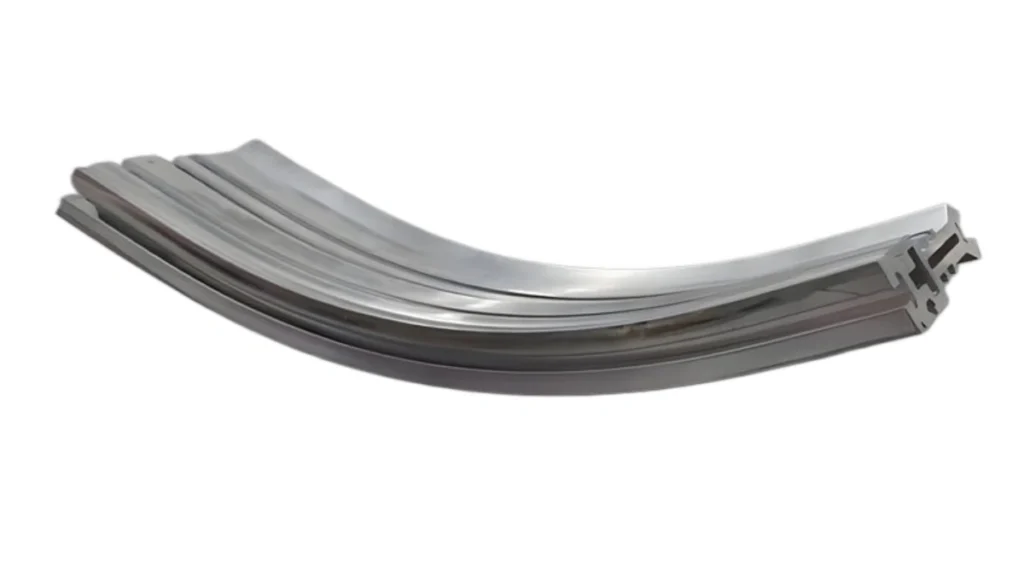
Aluminum Profile Stretch Bending service for frames

II. Temperature Dynamics: Adapting to Alloy Characteristics

Aluminum alloys behave differently depending on their thermal state. Selecting between cold and hot aluminum profile stretch bending is a strategic decision based on the alloy’s temper and the complexity of the desired curve.

Comparative Analysis of Thermal Environments

Тип сгибанияTemperature RangeIdeal MaterialsAdvantages & Considerations
Cold Stretch BendingAmbient (15–25°C)6063-T5, 6061-T4, 1xxx/3xxx seriesPros: Superior surface finish, no oxidation. Cons: Requires higher tension, high springback risk.
Warm/Hot Stretch Bending150–300°C7xxx series (7075), Aluminum-Lithium alloysPros: Reduces forming force by >30%, enables tight radii. Cons: Potential for surface scaling, requires post-process cooling.

The Role of Thermal Expansion and Grain Structure

When performing hot aluminum profile stretch bending, temperature uniformity is paramount. Localized “hot spots” can lead to grain growth, which weakens the mechanical properties of the final part.

  • Cooling Protocols: After hot forming, profiles should undergo controlled slow cooling. Rapid quenching can introduce internal thermal stresses that lead to warping once the part is released from the jig.
  • Energy Efficiency: In modern SEO-optimized manufacturing workflows, induction heating is preferred over furnace heating for its ability to target specific sections of the profile, saving energy and maintaining the integrity of straight sections.

III. Mastering Springback Compensation: The Key to Dimensional Accuracy

Springback (elastic recovery) is the single greatest challenge in aluminum profile stretch bending. Because aluminum has a relatively low Modulus of Elasticity (approx. 70 GPa, compared to 210 GPa for steel), it “remembers” its original shape more stubbornly than other metals.

1. Predicting the Springback Magnitude

For high-strength alloys like 6061-T6, a typical springback angle ranges from 5° to 8°. Hollow extrusions with thin walls are particularly susceptible due to their lower moment of inertia.

2. Strategic Compensation Methods

A. The Over-Bending Technique

This is the most common manual adjustment. The profile is bent to an angle sharper than the final target.

  • Rule of Thumb: If the target is a 90° bend, the tool might be designed for a 95° or 96° bend.
  • Calculation: Compensation is usually Target Angle + 3° to 6°, depending on the radius-to-thickness ratio.

B. Advanced Mold/Die Compensation (CAE Integration)

In the era of Industry 4.0, “trial and error” is being replaced by Computer-Aided Engineering (CAE).

  • Simulation Tools: Software like ABAQUSANSYS, or AutoForm is used to perform Finite Element Analysis (FEA).
  • Accuracy: By simulating the stress-strain curve of the specific aluminum batch, engineers can design “counter-curvature” into the mold. This reduces the error margin to as little as ±0.75°.

C. Incremental Pressure Dwell (Stress Relaxation)

By holding the profile under tension at the end of the stroke, you allow for stress relaxation.

  • Dwell Time: 5 to 10 seconds is the industry standard.
  • Impact: This simple step can stabilize the springback rate to within 3.2%, a significant improvement over immediate release.

3. The Hierarchy of Influence (Orthogonal Testing Results)

Based on empirical industrial data, the factors affecting springback are ranked as follows:

  1. Bending Stretch Amount (Highest Impact)
  2. Friction Coefficient
  3. Post-tensioning Force
  4. Pre-tensioning Force (Lowest Impact)

The takeaway for engineers: If your part is out of tolerance, adjust your total stretch percentage before changing your pre-tension settings.
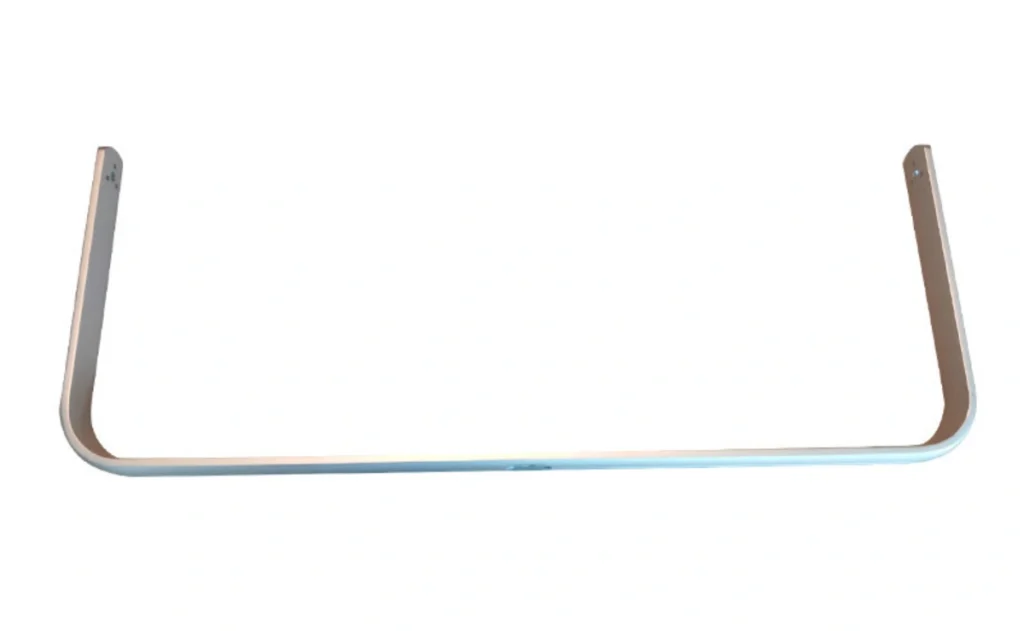
Custom Aluminum Profile Stretch Bending for windows

IV. Holistic Parameter Control: Friction, Speed, and Tooling

Beyond tension and temperature, secondary parameters play a vital role in the quality of aluminum profile stretch bending.

1. Friction and Lubrication

Friction between the profile and the die can cause surface scratching and uneven stretching.

  • Target Coefficient: 0.1 to 0.3.
  • Lubricant Choice: Use high-pressure vegetable-based oils or specialized synthetic lubricants. For aerospace parts, ensure the lubricant is “non-staining” to prevent interference with subsequent anodizing or painting processes.

2. Bending Speed: Finding the “Sweet Spot”

  • Recommended Speed: 0.5–2.0 meters per minute.
  • Why it matters: Aluminum is strain-rate sensitive. Bending too fast can cause local necking (thinning) and fracture. Bending too slowly decreases factory throughput and can lead to uneven cooling in hot-bending scenarios.

3. Die Fillet Radius

The radius of the die entry and exit points must be carefully calculated.

  • Typical Range: 50 mm to 200 mm.
  • Risk Mitigation: A radius that is too small will create stress concentrations and “tool marks” on the aluminum surface. A radius that is too large makes it difficult to maintain the tangency points of the curve.

V. Material Matters: Alloy-Specific Considerations

Not all aluminum is created equal. The success of a stretch bending project often depends on the initial temper of the extrusion.
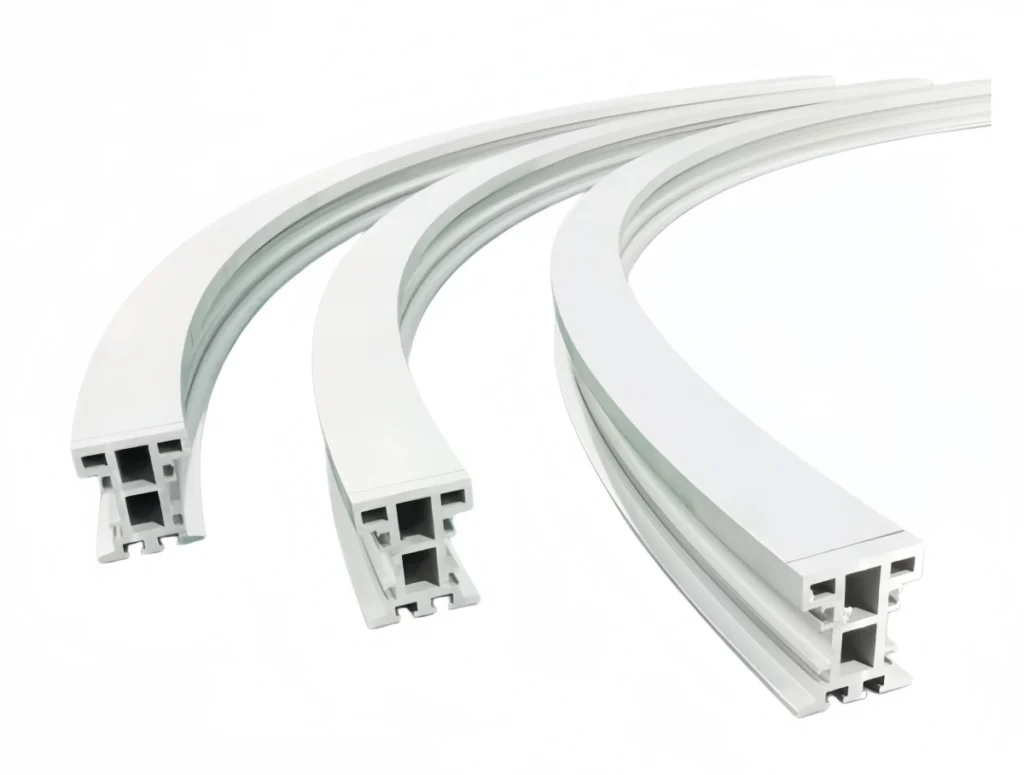
  • 6063-T5: Excellent for architectural curves. It has high ductility and provides a beautiful surface finish but requires careful springback management.
  • 6061-T6: The workhorse of the industry. It offers a great strength-to-weight ratio but has a narrower window for plastic deformation.
  • 7xxx Series: These are extremely high-strength and brittle. They almost always require Hot Stretch Bending or a specialized solution-annealing process prior to bending.
Industrial Aluminum Profile Stretch Bending factory

VI. Troubleshooting Common Defects in Stretch Bending

Even with the best parameters, issues can arise. Here is a quick reference for quality control:
  1. Wrinkling (Inner Radius): Usually caused by insufficient tension. Solution: Increase pre-tension or bending stretch.
  2. Wall Thinning/Cracking (Outer Radius): Caused by excessive tension or a radius that is too tight. Solution: Reduce bending stretch or increase temperature.
  3. Cross-Sectional Distortion: Common in hollow profiles. Solution: Use internal supports such as flexible mandrels, sand filling, or low-melting-point alloy fillers during the bend.
  4. Surface Galling: Caused by poor lubrication or die wear. Solution: Polish the die and apply high-performance lubricants.
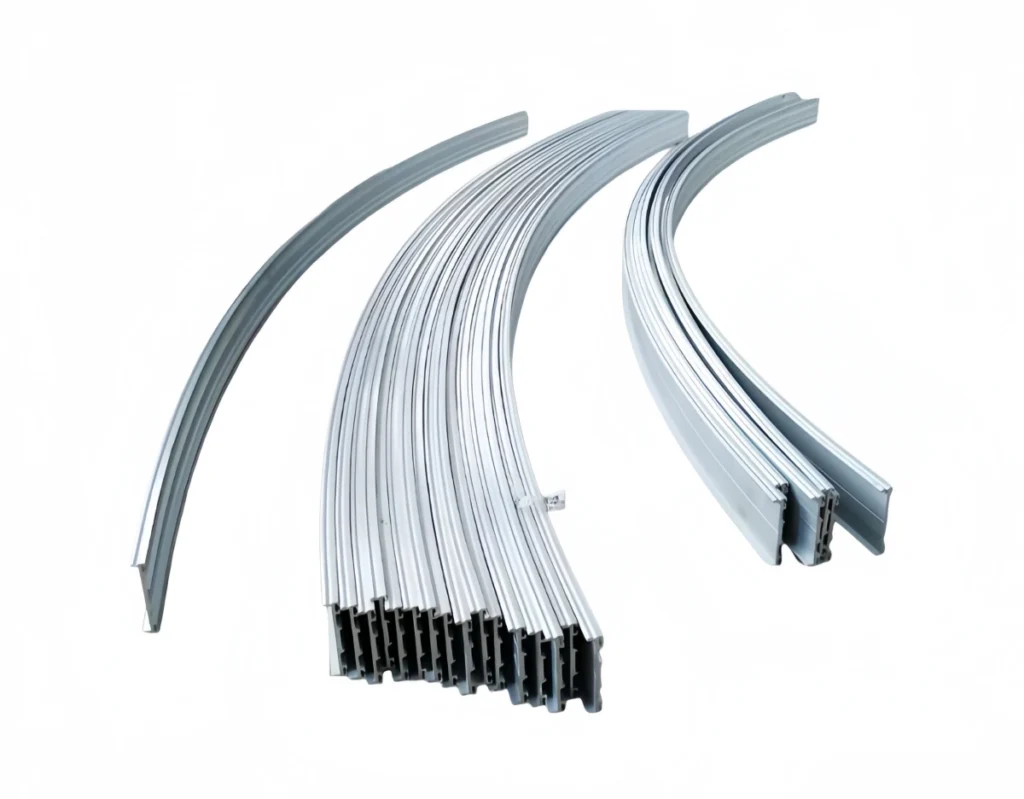
Precision Aluminum Profile Stretch Bending parts

VII. Conclusion: The Future of Aluminum Stretch Bending

As industries move toward “Green Manufacturing” and “Electric Mobility,” the role of aluminum profile stretch bending will only grow. By mastering the synergy between tension control, thermal management, and CAE-driven springback compensation, manufacturers can produce components that are lighter, stronger, and more precise than ever before.

For companies looking to optimize their production, investing in CNC Multi-Axis Stretch Bending machines is the path forward. These systems allow for real-time adjustments, ensuring that every piece—from the first to the thousandth—meets the rigorous tolerances required in today’s global market.