Адрес
304 Северный кардинал
Улица Дорчестер Сентер, MA 02124
Рабочие часы
Понедельник - пятница: 7AM - 7PM
Выходные: 10AM - 5PM
Адрес
304 Северный кардинал
Улица Дорчестер Сентер, MA 02124
Рабочие часы
Понедельник - пятница: 7AM - 7PM
Выходные: 10AM - 5PM
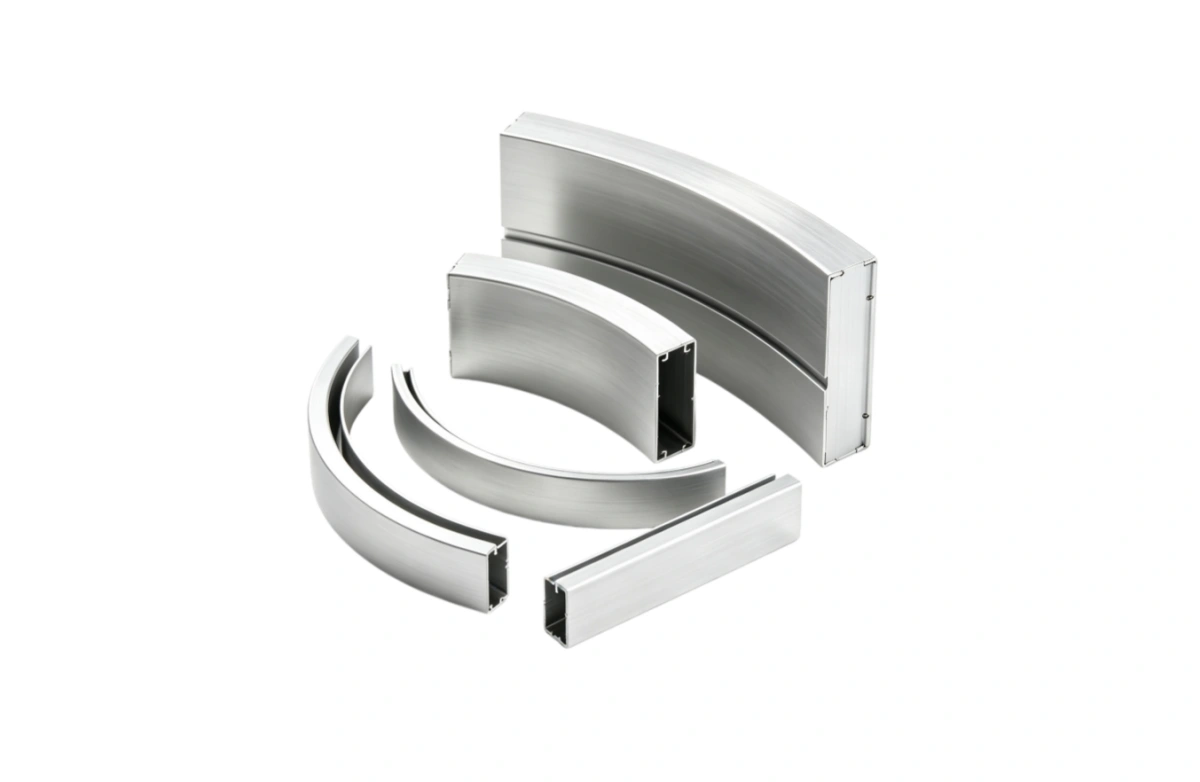
I have consulted dozens of global facade engineers troubled by defective aluminum stretch bending profiles every year.
Standardized stretch bending processes, differentiated inner & outer arc control and strict tolerance rules produce flawless aluminum stretch bending profiles for curved curtain wall construction.
Many overseas purchasing managers underestimate the complex metallurgical logic of aluminum stretch bending, which causes mass scrap and project delays. This complete high-quality guide covers all core techniques, defect solutions and site installation tips for aluminum stretch bending profiles.
I fixed multiple failed facade projects caused by incomplete aluminum stretch bending workflows for my international clients.
Cold stretch bending relies on pre-stretching, custom molds and multi-stage inspection to eliminate wrinkles, cracks and excessive springback on all aluminum stretch bending profiles.
Aluminum stretch bending is a dedicated cold forming technology for complex hollow curtain wall extrusions. It differs greatly from basic press bending, which only applies local compression without balanced axial tension. Press bending easily creates uneven stress, while stretch bending applies stable pulling force before shaping, which is the key to smooth, defect-free aluminum stretch bending profiles. All qualified manufacturers follow four sequential standardized steps for consistent output, and every stage carries strict execution standards based on international glass curtain wall codes.
All aluminum stretch bending profiles start with rigorous blank inspection. Factories only adopt certified 6063-T5 aluminum extrusions, the most widely used alloy for outdoor building facades. Inspectors reject any raw material with torsion, surface scratches or uneven wall thickness. Unstraight blanks will form irregular stress distribution during stretching, which leads to cavity collapse and distorted arcs after forming. Automatic straightening machines flatten all incoming profiles to a perfectly flat baseline, eliminating around 40% of common finished defects of aluminum stretch bending profiles at the source. Technicians also test alloy elongation performance in advance to judge safe bending limits for different cross-section sizes.
Mold precision directly decides the final arc accuracy of aluminum stretch bending profiles. Engineering teams design exclusive forming dies fully matched with architects’ drawings, including target bending radius, mullion cross-section and beam structure. All mold contact surfaces receive ultra-fine mirror polishing to protect pre-anodized aluminum surfaces from scratches. Mold inner grooves lock profile side flanges tightly to stop horizontal shifting under tension. For thin-wall small-radius aluminum stretch bending profiles, manufacturers install built-in core supports inside molds to prevent hollow cavity depression, a frequent industry pain point for curved facades.
This core forming step determines the overall quality of aluminum stretch bending profiles. Operators apply constant axial tension within the aluminum alloy’s yield limit before attaching the profile to curved molds. Uniform tension spreads stress evenly across the whole cross-section, so the inner arc will not pile up metal wrinkles and the outer wall avoids tensile micro-cracks. Our factory sets separate tension parameters for distinct wall thickness and radii, instead of universal settings used by small workshops. Practical production data shows the theoretical single-side stretching volume of 6063-T5 profiles is 12.18mm, and we control actual stretching length at 11.60mm with only 0.48mm error to balance forming effect and structural integrity. When the distance between machine rotation center and stop point is less than 5mm, the aluminum profile will stay under over-compression and form dents, so we strictly avoid this parameter range in all production schedules. The industry unified elongation formula is (Outer R − Inner R) ÷ Inner R × 100%, and the safe elongation cap is fixed at 10% to prevent permanent cracking without secondary material pre-treatment.
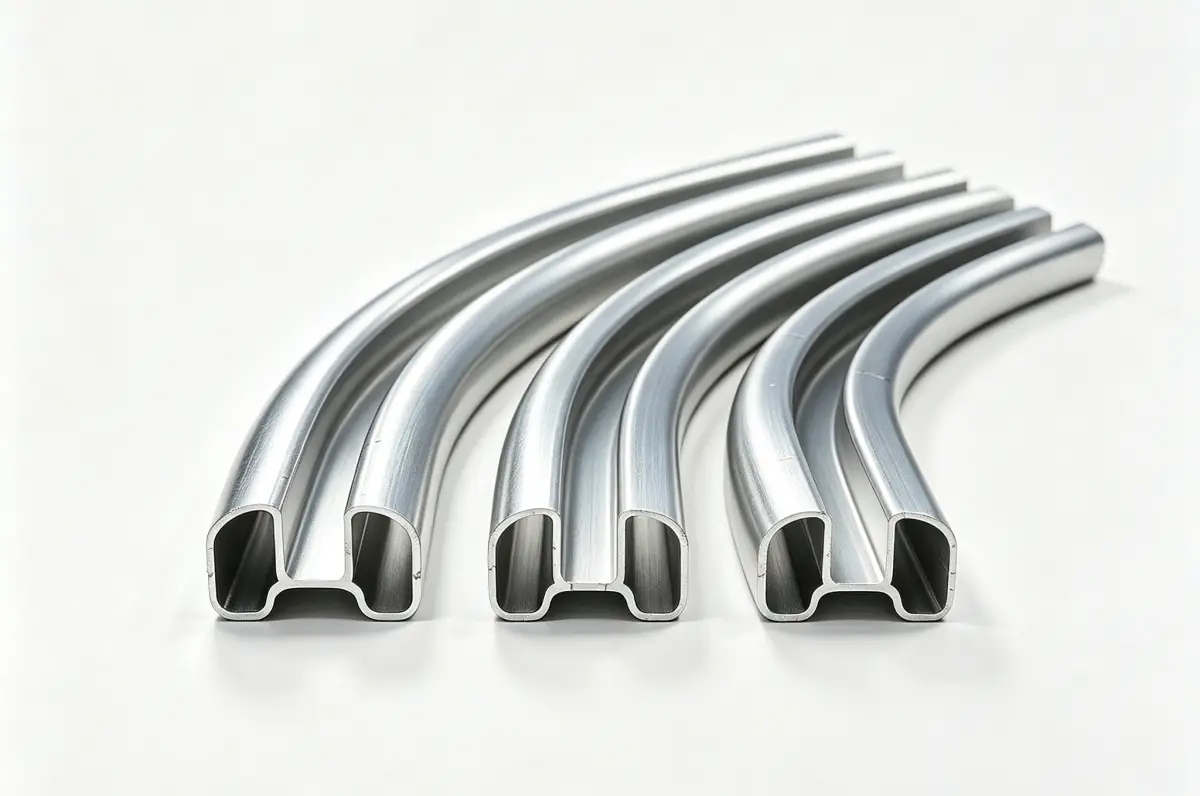
After completing bending, operators release tension slowly to cut springback influence. Minor arc deviations get light manual calibration without damaging the aluminum surface. Then all aluminum stretch bending profiles enter full-item inspection before packaging. Inspectors measure arc smoothness, cross-section roundness, overall length and hole position one by one. Only parts that hit all tolerance standards can move to export packaging and construction delivery. Surface inspection covers every inch to filter out folds, pits, scratches and micro-cracks as required by curtain wall engineering specifications.
| Processing Phase | Core Control Targets For Aluminum Stretch Bending Profiles | Common Defects From Improper Operation |
|---|---|---|
| Raw Material Prep | Straight, scratch-free 6063-T5 extrusions with stable elongation | Torsion, uneven bending stress, arc distortion |
| Custom Mold Making | Polished contact surfaces, matched locking grooves, inner cavity supports | Surface scratches, profile shifting, hollow collapse |
| Pre-Stretch Forming | Elongation controlled below 10%, stretching error ≤0.48mm | Outer wall cracks, inner arc wrinkling, severe springback |
| Post-Production Test | Full dimensional & surface compliance inspection | Assembly offset, uneven facade curved lines |
I see over half of curtain wall production scrap comes from mixed QC standards for inner and outer arc aluminum stretch bending profiles.
Inner arc aluminum stretch bending profiles feature stable forming, while outer arc versions demand strict verticality inspection to stop warping and on-site assembly failure.
Curtain wall projects use two core types of aluminum stretch bending profiles: inner arc bending and outer arc bending. Their force distribution, forming difficulty, inspection focus and post-repair workload are completely separate. Many small fabricators use identical process rules for both categories, which generates large batches of unusable curved aluminum parts and raises overall project costs significantly. Global facade contractors need to master their unique characteristics to communicate clear technical requirements to suppliers.
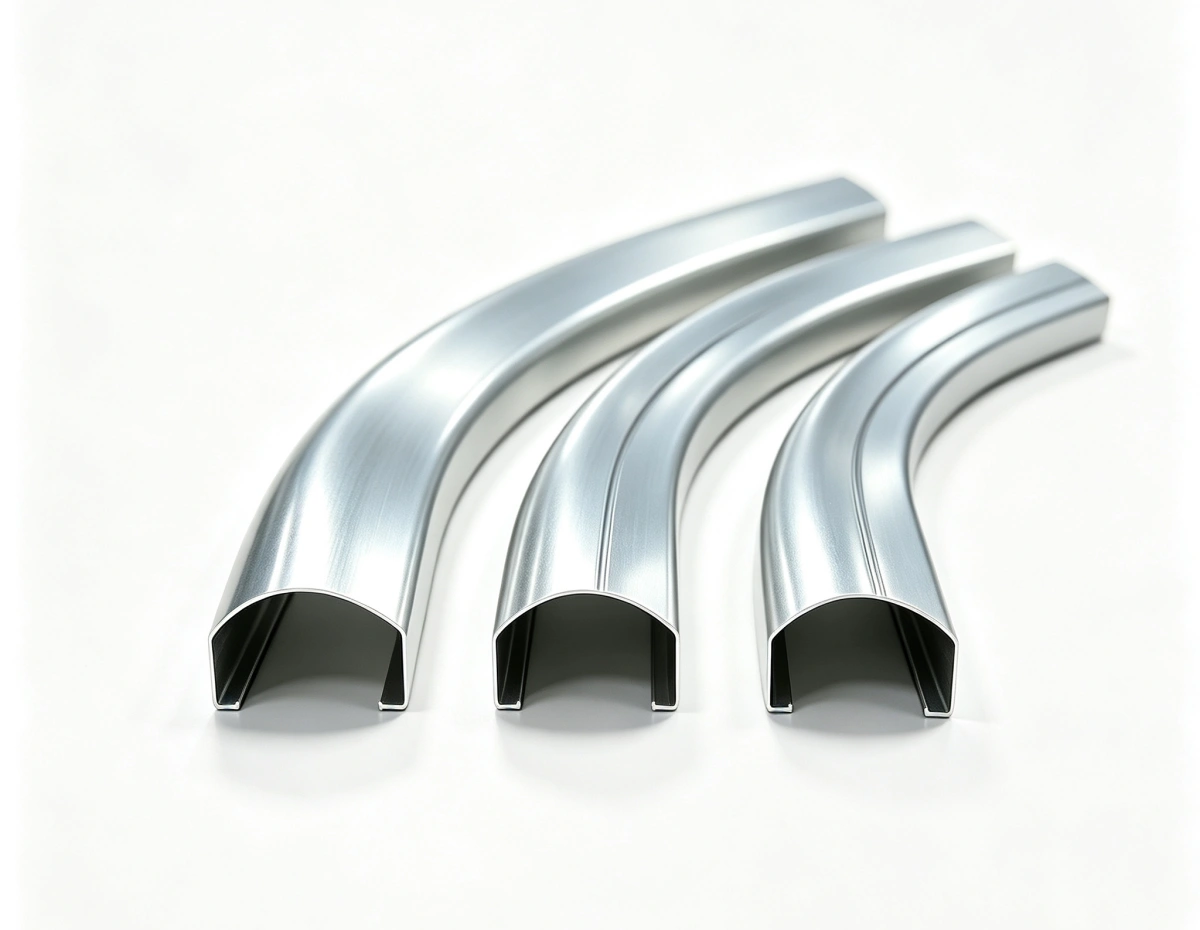
Inner arc aluminum stretch bending profiles place the profile’s side flange on the inner side of the finished curve. Vertical supporting edges lock firmly inside mold grooves during stretching, so the whole aluminum part bears balanced pressure without free floating segments after tension release. Outer arc aluminum stretch bending profiles set side flanges on the exterior of the arc. Only two ends are clamped by machine fixtures, and the middle profile body remains suspended during forming. After tension unloading, elastic springback easily pulls vertical flanks out of perpendicular alignment with assembly end faces, creating unrepairable warping flaws.
Inner arc bending has a high mass production yield rate, so quality inspectors mainly monitor cross-section stability. Hollow cavity mullions easily cave in under inner compressive force, so roundness gauges are mandatory testing tools for every finished piece. Post-forming correction work is minimal; slight uneven arcs only need light pressure adjustment to match design drawings. Most medium and small curved facade projects choose inner arc aluminum stretch bending profiles for steady processing performance and low scrap loss rate.
Outer arc bending is the hardest category in aluminum stretch bending profile manufacturing. The most damaging hidden defect is post-forming warping. Warped profiles have non-perpendicular vertical edges, which cannot lock into curtain wall frames and create wide assembly gaps plus water leakage risks on finished buildings. Our factory adds 100% verticality testing as a compulsory procedure for all outer arc aluminum stretch bending profiles. Technicians adjust mold height during trial production to make aluminum slide smoothly along mold guiding surfaces, reducing warping risk by over 70%. Post-production reshaping requires heavy manual labor, so all large-scale outer arc facade orders must produce trial samples before mass manufacturing to adjust tension and mold parameters in advance.
| Comparison Item | Inner Arc Aluminum Stretch Bending Profiles | Outer Arc Aluminum Stretch Bending Profiles |
|---|---|---|
| Forming Difficulty | Low, uniform stress distribution | High, suspended middle section after clamping |
| Main Quality Risk | Hollow cavity collapse & cross-section distortion | Profile warping, non-perpendicular assembly flanges |
| Mandatory QC Item | Hollow section roundness measurement | Verticality test of end face vertical edges |
| Post-Bending Repair Workload | Light, simple minor arc adjustment | Heavy, labor-intensive manual reshaping |
I help North American and European buyers filter unqualified suppliers who ignore official tolerance limits for aluminum stretch bending profiles every week.
Fixed length, hole position and curved radius tolerance rules set clear quality benchmarks for all construction-grade aluminum stretch bending profiles.
Uncontrolled dimensional deviation ranks among the top three complaints about aluminum stretch bending profiles from international construction purchasers. When bending workshops skip systematic size testing, finished curved extrusions cannot match prefabricated curtain wall frames, delaying overall construction schedules and incurring extra labor fees for on-site modification. All our aluminum stretch bending profiles fully comply with global glass curtain wall technical codes with fixed tolerance thresholds for length, hole position and arc radius.
Load-bearing vertical mullion aluminum stretch bending profiles allow a total length deviation of ±1.0mm. Horizontal cross beams carry lighter structural weight, so tolerance tightens to ±0.5mm. Excessive length error creates uneven vertical seams after curtain wall frame assembly. CNC fixed-length saws cut all raw blanks before stretch bending to lock dimension within permitted ranges.
All connecting bolt holes on aluminum stretch bending profiles must stay within ±0.5mm position deviation. Tiny hole offset blocks bolt penetration into matching frames, forcing construction teams to re-drill holes on-site. On-site drilling destroys the protective anodized coating and weakens long-term structural safety. Coordinate measuring machines scan hole coordinates for every production batch during final inspection to eliminate position errors.
Arc uniformity decides the visual effect of curved facades, so manufacturers split tolerance rules by radius size. For aluminum stretch bending profiles with curve radius under 1 meter, length deviation per meter must be less than ±1mm. For arcs wider than 1 meter, the standard loosens slightly to ±2mm per meter. Any profile exceeding these limits forms wavy, irregular exterior curves that fail architects’ aesthetic design requirements.
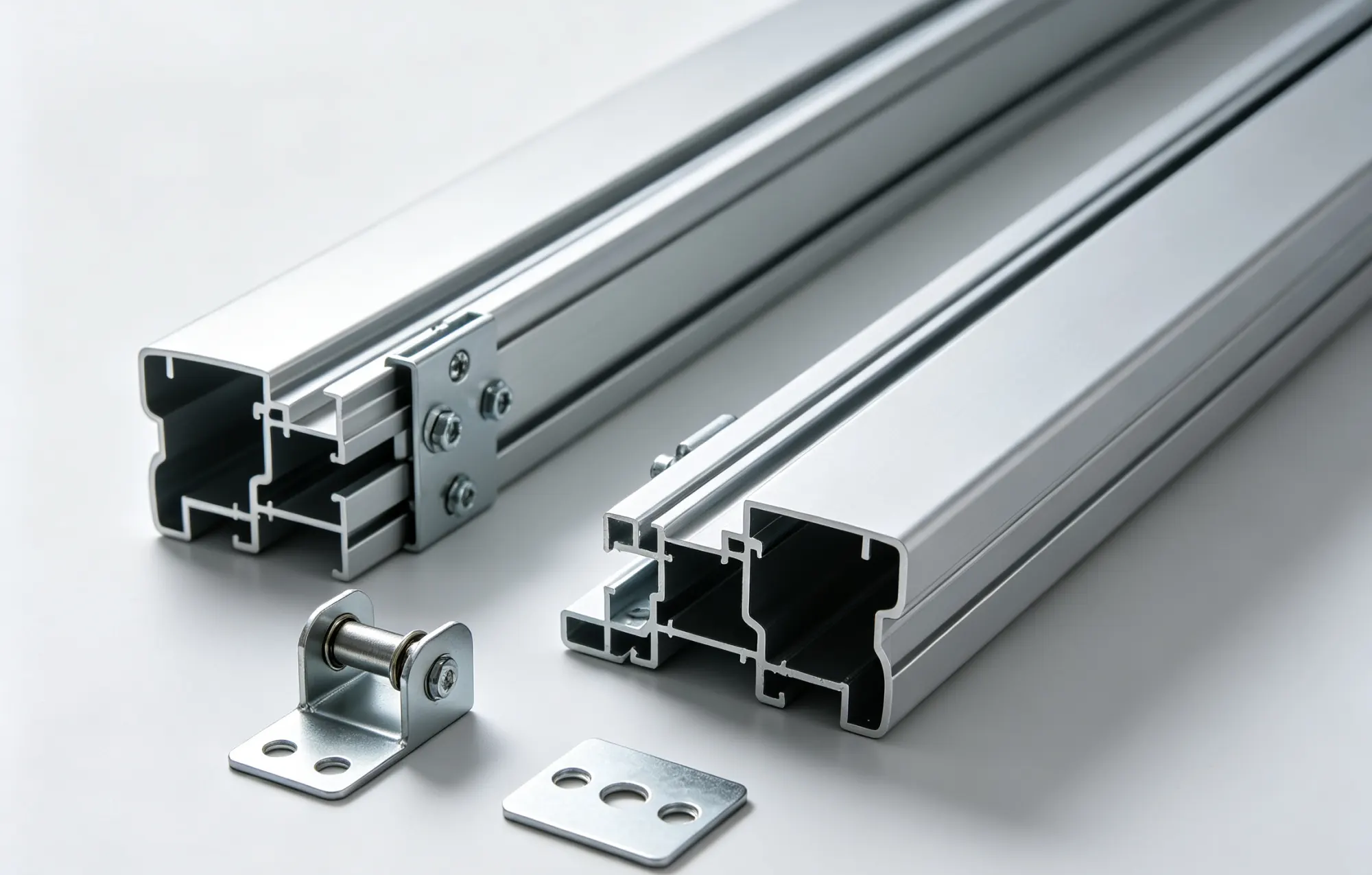
6063-T5 aluminum alloy has a strict stretch bending elongation cap of 10%. If stretching volume surpasses this threshold, micro-cracks appear on outer arc walls and expand under outdoor temperature fluctuations over years. For small-radius bending projects with elongation near the 10% limit, factories conduct extra pre-stretching sample testing to adjust tension parameters before full mass production.
I share practical pre-production allowance design skills to eliminate curtain wall assembly delays caused by aluminum stretch bending profile dimensional mismatches.
Reserve clamping stock length and follow shaft-negative hole-positive tolerance matching to achieve seamless installation of aluminum stretch bending profiles.
Even perfectly manufactured aluminum stretch bending profiles face assembly obstacles without standardized processing allowance planning before production. Many overseas facade contractors overlook reserved size design and cut qualified curved extrusions on-site, ruining surface coating integrity and dimensional accuracy. Three core industry-standard methods guarantee smooth installation for all aluminum stretch bending profiles used in curved curtain wall projects.
All raw aluminum blanks for stretch bending require extra clamping length for machine fixtures. Factories reserve 300mm stock on both ends of every aluminum stretch bending profile, which get fully removed after forming. Designers also add a calculated forming segment equal to 2.1 × (Outer Radius − Inner Radius) to each blank to balance tension distribution and stop end-section warping. Without this reserved section, curved shapes near profile ends deform and become unfit for curtain wall connection.
This classic assembly principle solves fit conflicts between aluminum stretch bending profiles and metal connectors. All protruding shaft tenons adopt negative tolerance, meaning actual finished dimensions sit slightly smaller than drawing data. All slot and hole openings use positive tolerance, so real sizes marginally exceed design values. The tiny reserved gaps offset minor bending dimensional errors, allowing construction workers to install bolts without forced hammer impacts that scratch aluminum protective coatings.
For complex aluminum stretch bending profiles with large cross-sections, thin walls or ultra-small bending radii, manufacturers never launch mass production directly. Technicians produce 2 to 3 trial samples first to adjust mold height, stretching force and forming speed. Inspectors test arc smoothness, cross-section roundness and surface quality of trial aluminum stretch bending profiles. If samples show wrinkling, cavity collapse or warping, all process parameters get revised until samples fully meet all technical standards. Trial pre-production cuts bulk order scrap rate by over 60% and saves massive raw aluminum costs for global curtain wall buyers.
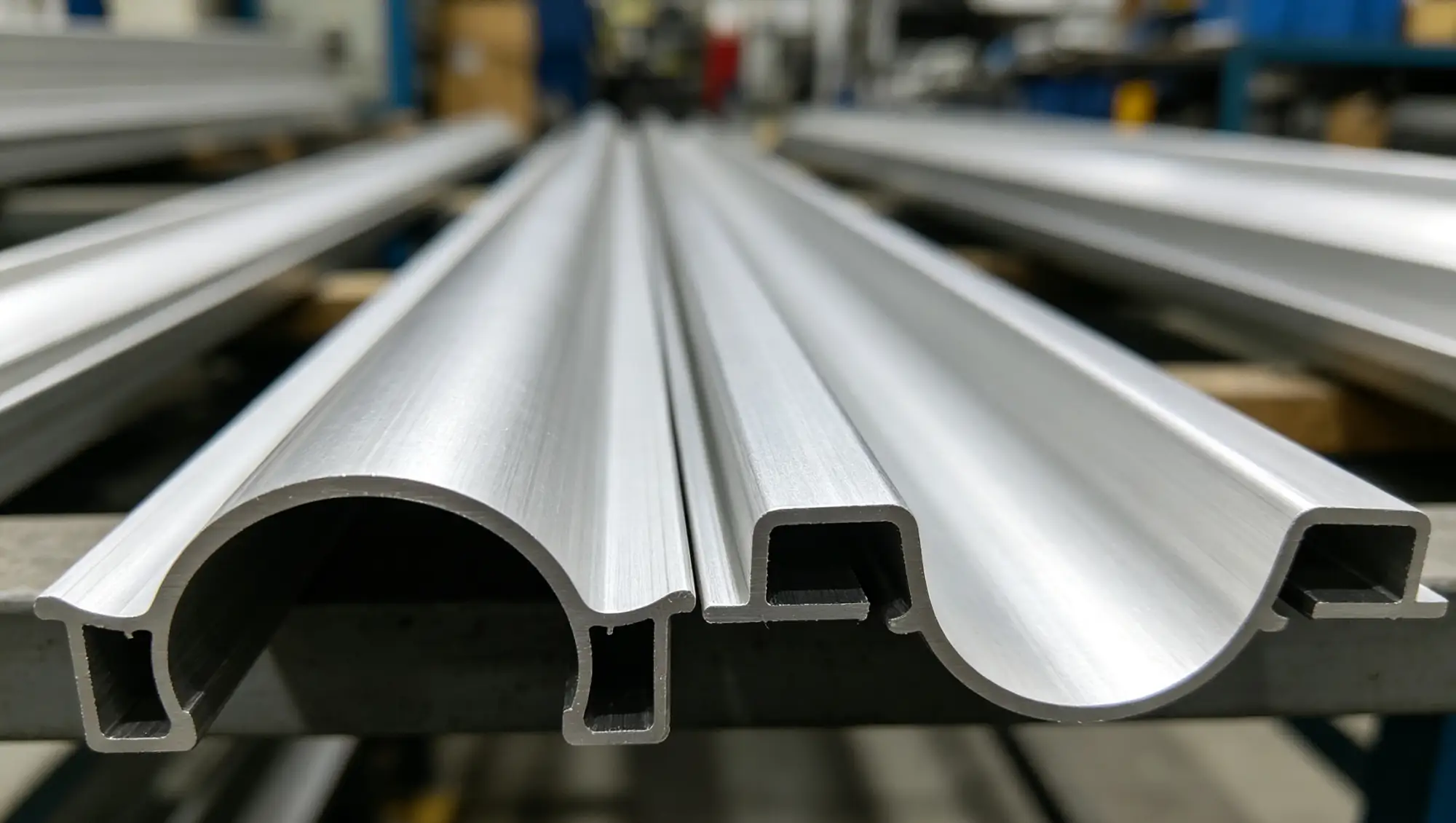
High-quality aluminum stretch bending profiles rely on systematic stretch bending workflows, differentiated inner & outer arc QC and strict tolerance standards to deliver stable, attractive curved curtain wall construction results.