Endereço
304 Norte Cardinal
St. Dorchester Center, MA 02124
Horas de trabalho
Segunda-feira a sexta-feira: 7h - 19h
Fim de semana: 10:00 - 17:00
Endereço
304 Norte Cardinal
St. Dorchester Center, MA 02124
Horas de trabalho
Segunda-feira a sexta-feira: 7h - 19h
Fim de semana: 10:00 - 17:00
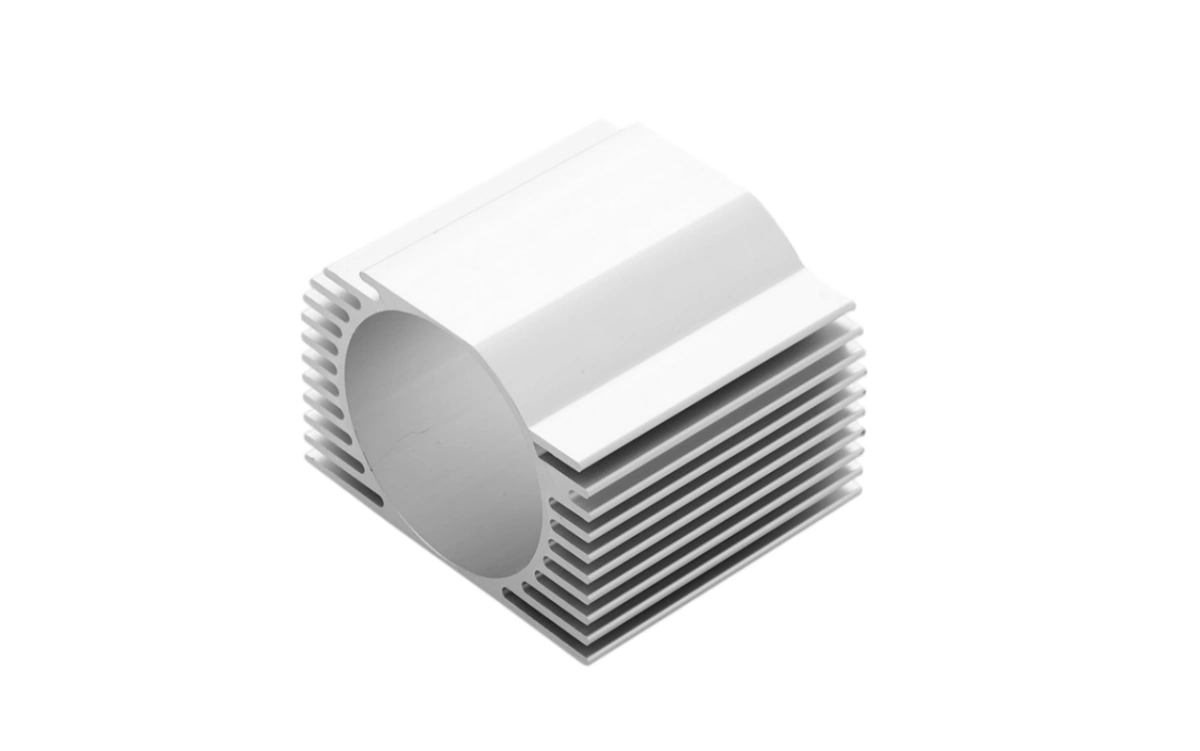
The modern architectural and industrial landscape relies heavily on lightweight, durable, and highly formable materials. Among the wide range of structural alloys available today, 6063 aluminum extrusion stands out as one of the most versatile and widely utilized solutions globally. Often referred to as architectural aluminum, this specific alloy provides an exceptional balance of mechanical strength, corrosion resistance, surface finish quality, and intricate extrudability.
Whether you are designing structural curtain wall systems, intricate LED heat sinks, or modular industrial enclosures, selecting the right extrusion profile is critical to achieving long-term structural performance, aesthetic appeal, and cost efficiency. This comprehensive guide explores the core mechanical properties, primary industrial applications, alloy comparison metrics, and custom manufacturing techniques associated with 6063 aluminum extrusion to help B2B buyers and structural engineers make fully informed procurement decisions.
To understand why 6063 aluminum extrusion is dominant across building and manufacturing sectors, it is necessary to examine its chemical composition and physical properties. Belonging to the 6000-series alloy family, its primary alloying elements are magnesium ($\text{Mg}$) and silicon ($\text{Si}$), which combine to form magnesium silicide ($\text{Mg}_2\text{Si}$). This compound enables the material to undergo precipitation hardening (heat treatment), significantly enhancing its tensile and yield strength without sacrificing ductility.
The chemical formulation of 6063 aluminum extrusion is precisely controlled to balance formability and post-heat-treatment strength. The typical elemental boundaries according to international alloy standards include:
| Physical / Mechanical Property | Typical Value (6063-T5) | Typical Value (6063-T6) | Metric / Unit |
| Density | $2.70$ | $2.70$ | $\text{g/cm}^3$ |
| Tensile Strength | $185$ | $240$ | $\text{MPa}$ |
| Resistência ao escoamento | $145$ | $200$ | $\text{MPa}$ |
| Thermal Conductivity | $209$ | $201$ | $\text{W/m}\cdot\text{K}$ |
| Electrical Conductivity | $53\%$ | $50\%$ | $\% \text{ IACS}$ |
| Modulus of Elasticity | $68.3$ | $68.3$ | $\text{GPa}$ |
| Poissons Ratio | $0.33$ | $0.33$ | Dimensionless |
| Elongation at Break | $12\%$ | $10\%$ | $\%$ |
| Brinell Hardness | $60$ | $73$ | $\text{HB}$ |
Because of this well-balanced property matrix, structural engineers can specify lighter profiles while maintaining high safety margins, ultimately lowering raw material consumption and transport expenses.
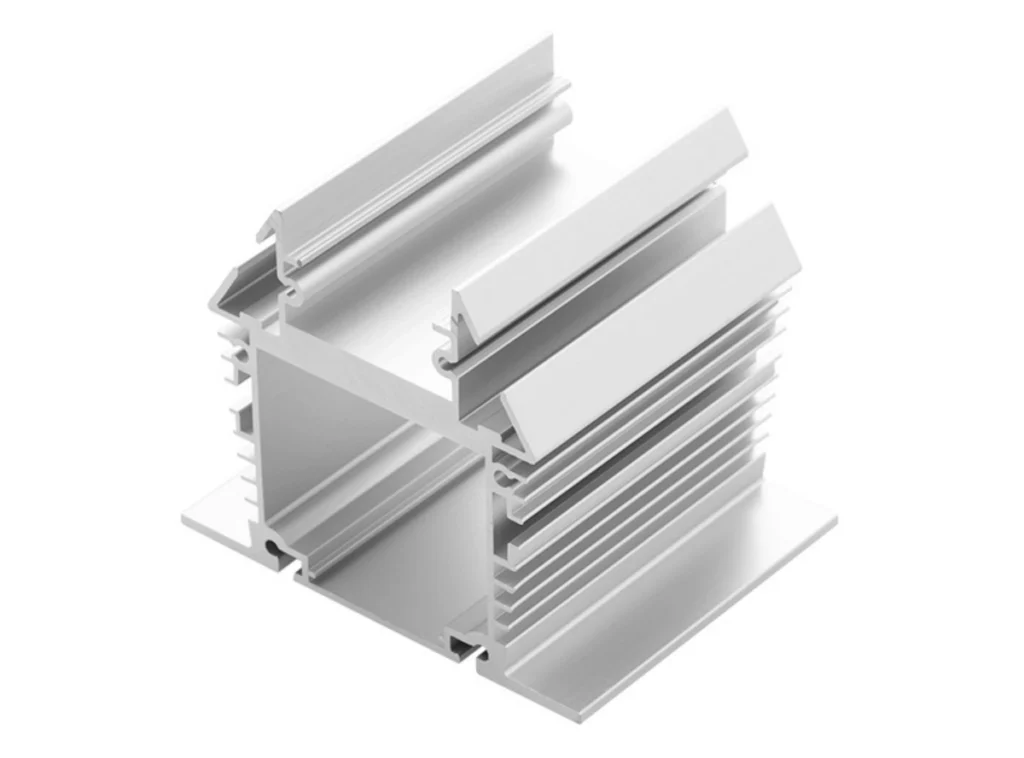
The seamless integration of aesthetic elegance, structural reliability, and high thermal conductivity allows 6063 aluminum extrusion to adapt to a wide range of commercial and technical sectors.
+-----------------------------------------------------------------------+
|              PRIMARY USES OF 6063 ALUMINUM EXTRUSION                  |
+-------------------+-------------------+-------------------------------+
| Industrial Sector | Key Components    | Core Benefit                  |
+-------------------+-------------------+-------------------------------+
| Architecture &    | Curtain Walls,    | Superior weatherability,      |
| Construction      | Windows, Doors    | flawless surface for coating  |
+-------------------+-------------------+-------------------------------+
| Electronics &     | Heat Sinks, LED   | High thermal conductivity,    |
| Lighting          | Housing Channels  | thin fin extrudability        |
+-------------------+-------------------+-------------------------------+
| Industrial        | T-Slot Framing,   | Modular assembly, high strength|
| Automation        | Conveyor Guides   | to weight ratio               |
+-------------------+-------------------+-------------------------------+
| Automotive &      | Bus Trim Rails,   | Weight reduction, resistance  |
| Transportation    | Battery Trays     | to road spray oxidation       |
+-------------------+-------------------+-------------------------------+
| Renewable         | Solar Racking,    | Long term durability in       |
| Energy            | Inverter Mounts   | harsh outdoor environments    |
+-------------------+-------------------+-------------------------------+
In commercial and residential construction, 6063 aluminum extrusion serves as the primary structural choice for curtain wall framing, structural glass mullions, door systems, and architectural louvers. Modern high-rise buildings demand structural profiles capable of withstanding severe wind loads and thermal cycling. The material’s dimensional stability prevents air and water infiltration over decades of outdoor exposure.
Efficient thermal dissipation is vital for extending the operational life of power electronics, power supplies, and high-output LED fixtures. With thermal conductivity reaching up to $209\text{ W/m}\cdot\text{K}$, 6063 aluminum extrusion profiles are routinely manufactured with intricate, high-density cooling fins. These shapes maximize total surface area, facilitating rapid natural or forced convection cooling.
Modern manufacturing facilities rely heavily on modular aluminum framing networks built using standardized 6063 structural extrusions (such as 2020, 3030, and 4040 T-slot profiles). These modular framing systems enable engineers to design custom machine guards, automated assembly lines, cleanroom partitions, and ergonomic workstations without requiring complex structural welding. The precision dimensions of extruded T-slots ensure rigid attachment with standard fasteners.
In the automotive and public transport sectors, reducing vehicle mass directly improves fuel economy and battery range. 6063 aluminum extrusion is utilized in passenger train window frames, luggage rack channels, bus body side rails, and electric vehicle (EV) battery enclosures. The alloy absorbs kinetic energy during crashes while providing ongoing resistance to road salt and atmospheric humidity.
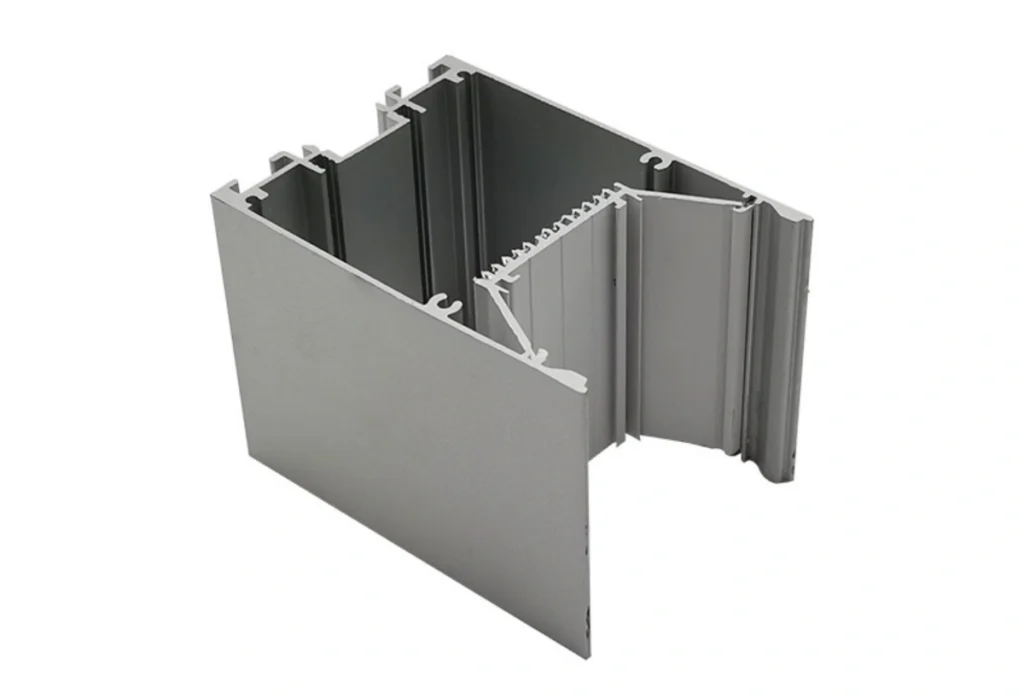
Designers and procurement managers frequently compare 6063 aluminum extrusion against its close structural sibling, 6061 aluminum extrusion. While both belong to the magnesium-silicon 6000-series family, key chemical variance creates distinct functional differences.
The underlying technical difference stems from alloy composition. 6061 contains higher levels of silicon and magnesium, alongside additions of copper ($0.15\% – 0.40\%$) and chromium, rendering it roughly $20\%$ to $30\%$ stronger under static mechanical loading. However, this increased hardness impairs high-speed extrudability and yields a coarser surface texture.
| Engineering Parameter | 6063 Aluminum Extrusion | 6061 Aluminum Extrusion |
| Primary Design Intent | Medium-High Strength, High Aesthetics | High Mechanical Load & Structural Integrity |
| Relative Extrudability | Excellent ($100\%$ baseline) | Good ($60\% – 70\%$ speed limit) |
| Qualidade do acabamento da superfície | Smooth, Architectural Quality | Standard Industrial / Utility Quality |
| Anodizing Response | Clear, Uniform, Decorative Finish | Slightly Dull / Dark Gray Cast |
| Tensile Strength (T6) | $\sim 240\text{ MPa}$ | $\sim 310\text{ MPa}$ |
| Yield Strength (T6) | $\sim 200\text{ MPa}$ | $\sim 276\text{ MPa}$ |
| Machinability Rating | Bom | Excelente |
| Typical Target Uses | Window Frames, Trim, Heat Sinks, Tubing | Marine Hulls, Aircraft Fittings, Heavy Bridges |
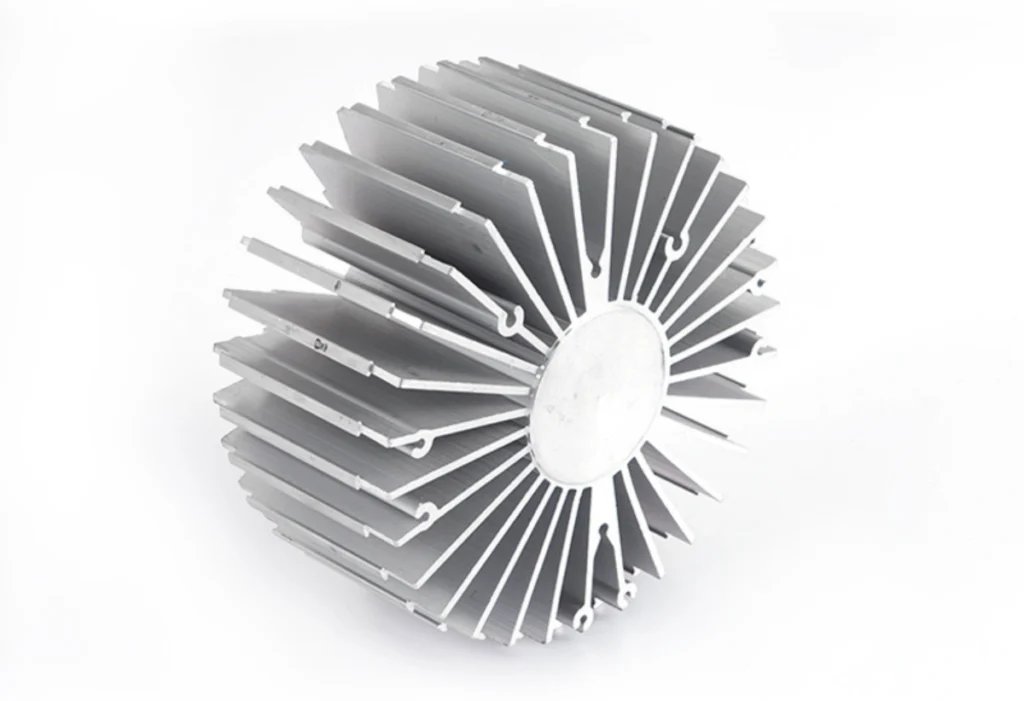
Producing high-precision 6063 aluminum extrusion profiles requires tight control across heat treatment stages, hydraulic extrusion pressures, and post-extrusion surface refinement.
+-----------------------------------------------------------------------+
|               6063 CUSTOM EXTRUSION MANUFACTURING FLOW                |
+-----------------------------------------------------------------------+
  [1. Billets Pre-Heating] ──> Target Temp: 430°C - 490°C
            │
            ▼
  [2. Hydraulic Pressing] ──> Extruded through Precision Tooling Die
            │
            ▼
  [3. Quenching & Cooling] ──> Forced Air or Water Spray Cooling
            │
            ▼
  [4. Mechanical Stretching] ──> Tension Straightening (1% - 2% Stretch)
            │
            ▼
  [5. Artificial Aging] ──> Ovens at 175°C - 190°C for T5/T6 Temper
            │
            ▼
  [6. Surface Finishing & CNC] ──> Anodizing / Powder Coating / Machining
Due to its chemical purity and refined grain structure, 6063 aluminum extrusion supports an exceptionally broad selection of surface treatments:
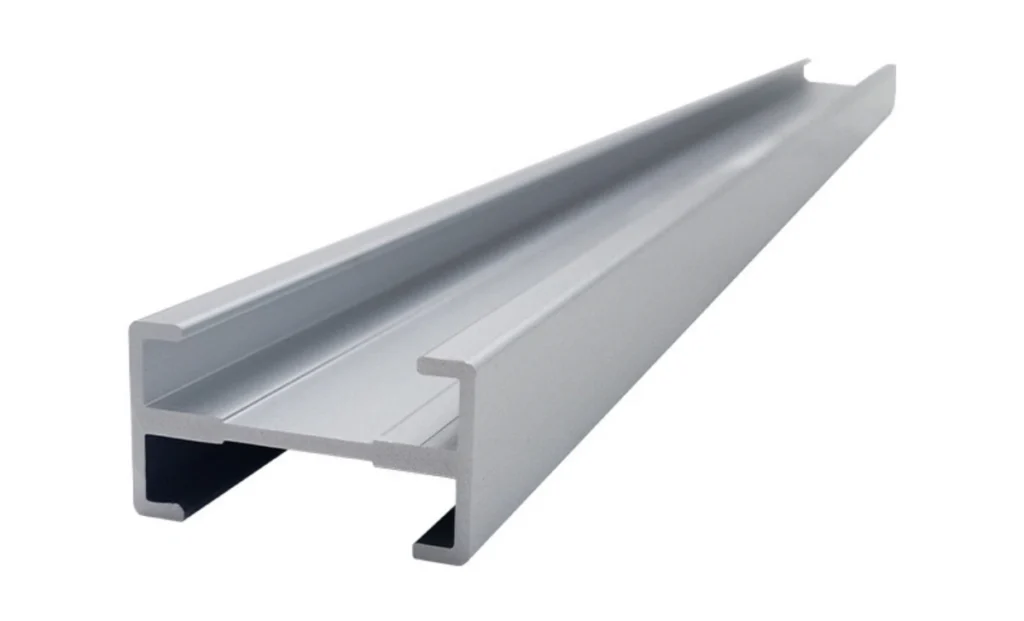
To assist engineering and purchasing teams in drafting technical specifications, purchase orders, and quality control documentation for custom 6063 aluminum extrusion orders, the reference table below outlines international tolerances, temper certifications, and manufacturing limits.
+-----------------------------------------------------------------------+
|               TECHNICAL SPECIFICATION QUICK REFERENCE                 |
+--------------------+--------------------------------------------------+
| Parameter          | Industry Standard / Technical Value              |
+--------------------+--------------------------------------------------+
| International      | ASTM B221, EN 755, EN 12020, ISO 6362,           |
| Standards          | GB/T 5237                                        |
+--------------------+--------------------------------------------------+
| Temper Options     | T4 (Solution Heat Treated & Naturally Aged)      |
| Available          | T5 (Cooled from Press & Artificially Aged)       |
|                    | T6 (Solution Heat Treated & Artificially Aged)   |
+--------------------+--------------------------------------------------+
| Wall Thickness     | Standard: 0.8 mm - 12.0 mm                        |
| Capabilities       | Ultra-thin options down to 0.6 mm                |
+--------------------+--------------------------------------------------+
| Profile Width      | Press Range: 50 Ton up to 10,000 Ton             |
| Circumscribed Dia. | Max Circle Size: 10 mm up to 500 mm              |
+--------------------+--------------------------------------------------+
| Dimensional        | Standard Tolerance: EN 755-9 / ASTM B221         |
| Tolerances         | High Precision Tolerance: EN 12020-2             |
+--------------------+--------------------------------------------------+
| Secondary CNC      | Precision Length Sawing ($\pm 0.2\text{ mm}$),   |
| Fabrication        | Milling, Drilling, Tapping, Stamping, Bending    |
+--------------------+--------------------------------------------------+
When sourcing custom 6063 aluminum extrusion profiles from manufacturing vendors, verify that the supplier implements key quality assurance protocols:
By taking advantage of the physical properties, high surface quality, and design flexibility of 6063 aluminum extrusion, product designers and structural engineers can build reliable, high-performance aluminum assemblies. Contact an experienced custom extrusion manufacturer early in your design phase to optimize profile geometry, minimize tooling expenses, and select the best surface finish for your application requirements.