Adresse
304 North Cardinal
St. Dorchester Center, MA 02124
Heures de travail
Du lundi au vendredi : de 7h00 à 19h00
Le week-end : 10H00 - 17H00
Adresse
304 North Cardinal
St. Dorchester Center, MA 02124
Heures de travail
Du lundi au vendredi : de 7h00 à 19h00
Le week-end : 10H00 - 17H00
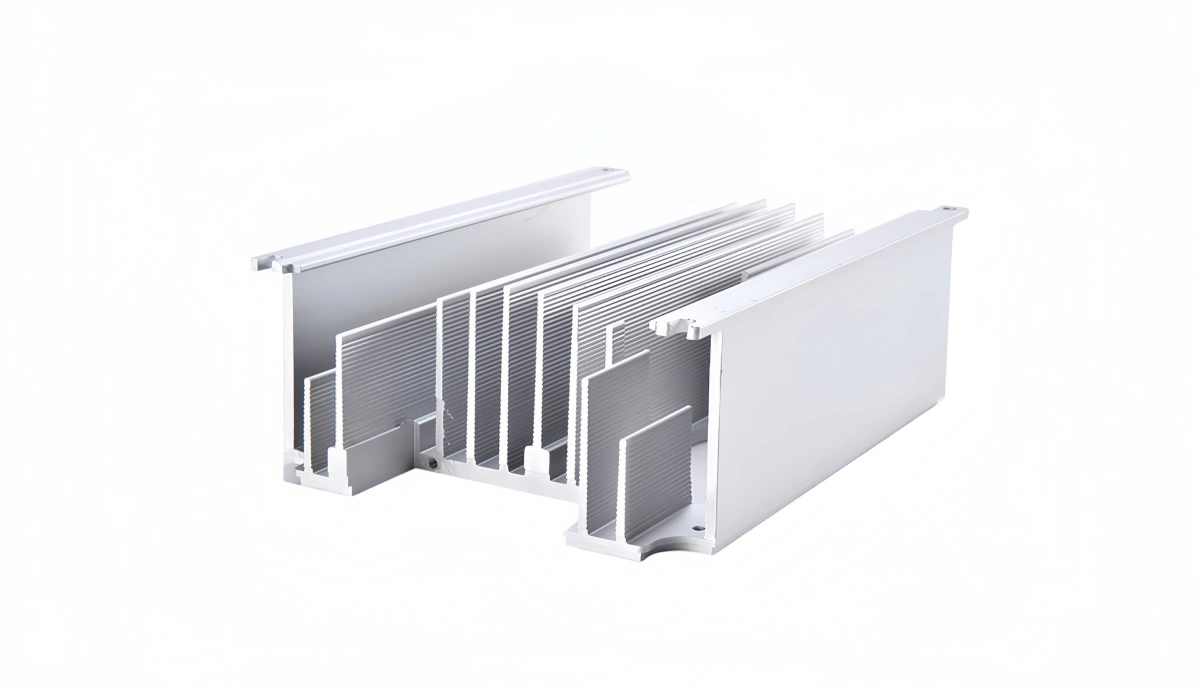
Modern high-power electronics, automotive systems, LED lighting, and industrial machinery require efficient thermal dissipation to maintain operational stability and extend component lifespans. As power densities increase across electronic assemblies, heat sinks manufactured from high-grade aluminum alloys have become the global standard for passive and active thermal management. Understanding how aluminum heat sink profiles perform under complex thermal loads—and how their design impacts manufacturing cost—is essential for engineering teams and B2B procurement managers alike.
This comprehensive guide examines alloy selection, core manufacturing processes, thermal geometry optimization, and critical design parameters necessary for procuring custom aluminum heat sink profiles.
At their core, aluminum heat sink profiles are specialized extruded or machined metal components designed to absorb thermal energy from sensitive heat-generating electronic components—such as CPUs, power transistors, IGBT modules, and LED arrays—and dissipate that energy into the surrounding air medium.
+-----------------------------------------------------------------------+
|                    THERMAL DISSIPATION PATHWAY                        |
+-----------------------------------------------------------------------+
  [1. Heat Source / Component] ──> High Heat Flux (e.g., IGBT / CPU)
            │
            ▼
  [2. Thermal Interface Material] ──> Eliminates Microscopic Air Gaps
            │
            ▼
  [3. Base Plate of Profile] ──> Spreads Heat Conductively Across Surface
            │
            ▼
  [4. Extended Fin Geometry] ──> Convects Heat to Surrounding Air Stream
The baseline efficiency of aluminum heat sink profiles depends heavily on the chemical composition and thermal conductivity of the chosen alloy. While pure aluminum offers exceptionally high thermal conductivity ($\approx 237 \text{ W/m}\cdot\text{K}$), it lacks the mechanical strength, machinability, and structural rigidity required for complex industrial profiles. Consequently, engineers utilize heat-treatable aluminum alloys formulated for both thermal transport and structural integrity.
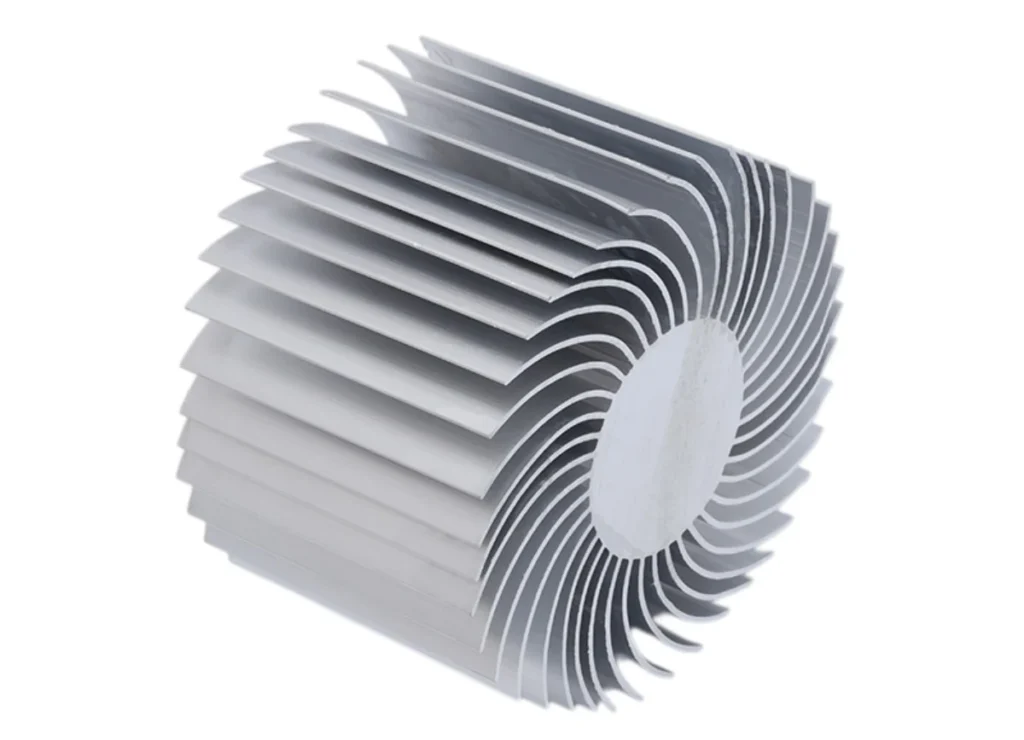
Selecting the right production process for aluminum heat sink profiles involves balancing thermal requirements, fin density, production volume, and NRE (Non-Recurring Engineering) tooling budgets.
+-----------------------------------------------------------------------+
|                MANUFACTURING PROCESS SELECTION MATRIX                 |
+-----------------------------------------------------------------------+
  [High Volume / Standard Density] ──> Hot Extrusion Process
  [High Fin Aspect Ratio / No NRE] ──> Skiving Technology
  [Low Volume / Complex Geometry]  ──> Precision CNC Milling
Extrusion remains the most cost-effective and dominant manufacturing method for high-volume aluminum heat sink profiles. Preheated aluminum billets are forced through hardened H13 steel dies under hydraulic pressure. This process produces continuous lengths of cross-sectional profiles featuring integrated base plates and vertical fin arrays.
Skiving involves using a high-precision slicing blade to shave thin sheets off a solid aluminum block and bend them vertically to form ultra-dense fin arrays. Because the fins and base plate are carved from a single piece of metal, there is zero interface thermal resistance. Skiving allows for significantly higher fin-aspect ratios than standard extruded aluminum heat sink profiles.
For low-volume prototypes, highly specialized liquid-cooling cold plates, or architectures requiring multi-directional airflow, full CNC machining from solid billet stock provides maximum design flexibility without requiring custom extrusion die tooling.
| Parameter / Feature | Profils extrudés | Skived Profiles | CNC Machined Profiles |
| Fin Aspect Ratio | Up to $10:1$ (Standard) / $20:1$ (High-Ratio) | Up to $50:1$ (Ultra-Dense) | Custom / Variable |
| Minimum Fin Thickness | $\approx 1.0 \text{ mm} – 1.5 \text{ mm}$ | Down to $0.2 \text{ mm} – 0.5 \text{ mm}$ | Limited by tool diameter |
| Tooling / NRE Cost | Moderate (Custom Die) | Very Low (Standard Cutters) | None (Digital CAM) |
| Unit Production Speed | Extremely High | Modéré | Low to Moderate |
| Thermal Efficiency | High (Omnidirectional option) | Superior (Zero Thermal Resistance) | Dependent on CAD design |
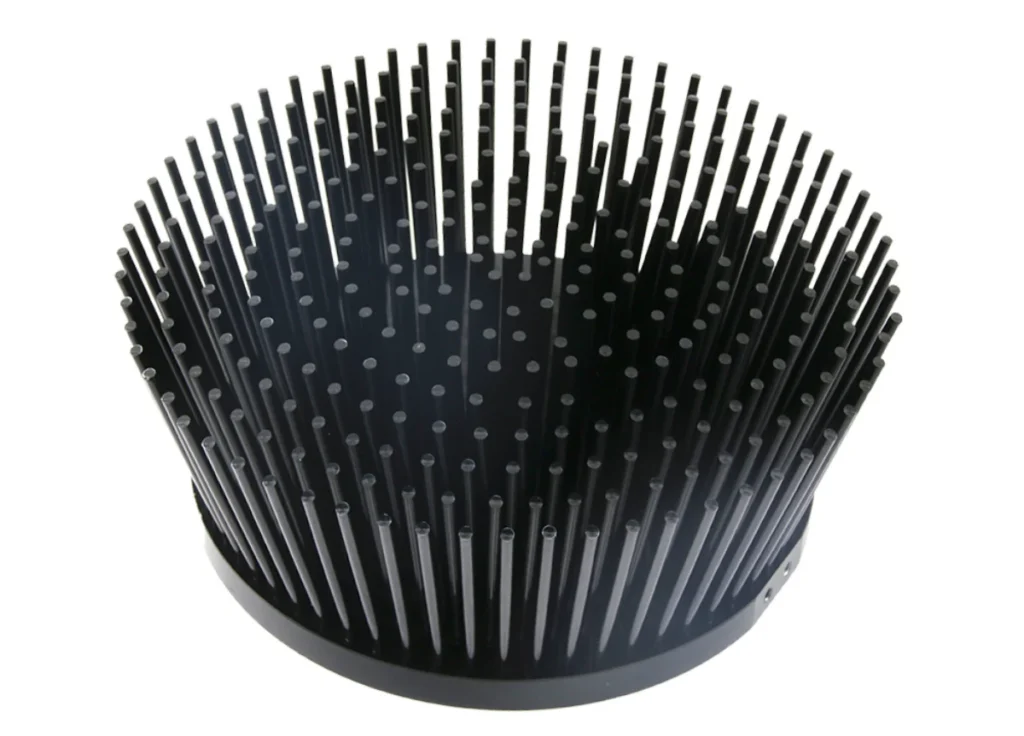
Achieving peak heat dissipation from aluminum heat sink profiles requires careful engineering of fluid dynamics, conductive cross-sections, and radiation surface treatments.
A common design flaw in custom aluminum heat sink profiles is an undersized base plate. The base plate acts as a heat spreader, moving thermal energy laterally away from concentrated heat sources (such as a power module) toward the outer fins. If the base plate is too thin, heat cannot spread effectively, leading to localized thermal bottlenecks.
Increasing the number of fins on aluminum heat sink profiles expands total surface area, but packing fins too closely together can severely impede airflow.
Raw, untreated bare aluminum has a very low thermal emissivity rating ($\approx 0.05$). Applying a anodized surface coating (such as black or clear anodizing) transforms the surface chemistry:
$$\text{Bare Aluminum Emissivity } (\epsilon \approx 0.05) \longrightarrow \text{Anodized Surface Emissivity } (\epsilon \approx 0.85 – 0.90)$$
Anodized aluminum heat sink profiles convert thermal energy into radiative heat transfer far more effectively, yielding up to a $10\% – 15\%$ improvement in total cooling capacity under natural convection conditions, while simultaneously providing robust corrosion and dielectric protection.
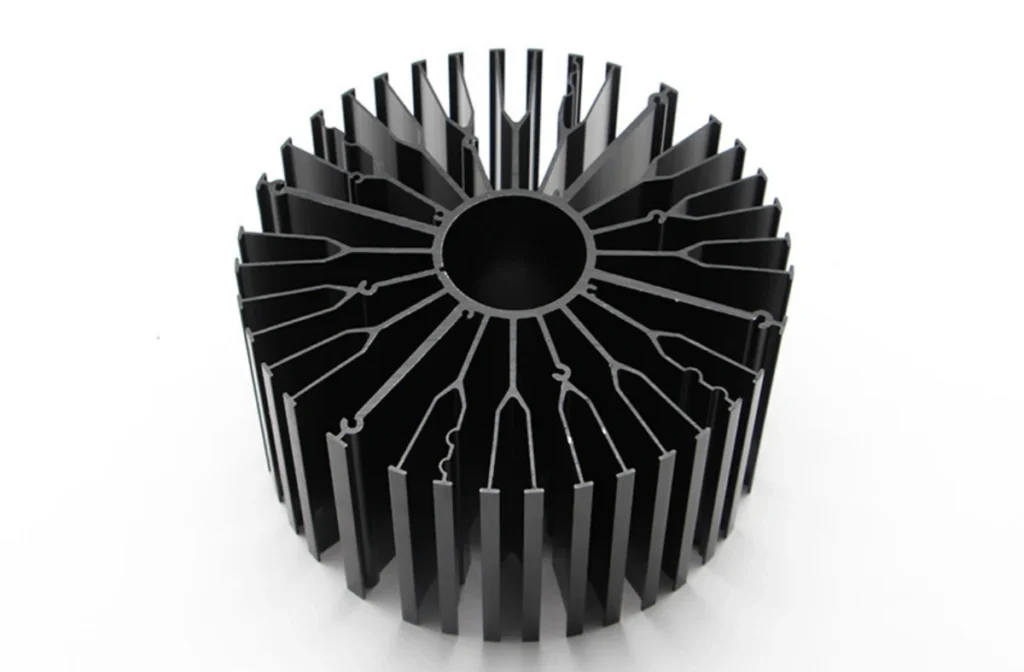
When procuring custom aluminum heat sink profiles, engineering and purchasing teams must evaluate both thermal performance requirements and manufacturing constraints to avoid unnecessary tooling costs or extended lead times.
+-----------------------------------------------------------------------+
|                B2B CUSTOM PROCUREMENT CHECKLIST                       |
+-----------------------------------------------------------------------+
  [1. Thermal Load Analysis] ──> Define Max TDP (Watts) & ΔT Limits
            │
            ▼
  [2. Extrusion Aspect Ratio] ──> Verify Fin Height to Gap Dimensions
            │
            ▼
  [3. Tolerances & Flatness] ──> Specify Precision CNC Fly-Cutting
            │
            ▼
  [4. Secondary Fabrication] ──> Map Tapping, Milling & Anodizing Steps
During the die design phase for aluminum heat sink profiles, the ratio of fin height to fin gap (aspect ratio) dictates tool strength. Standard extrusion equipment easily handles aspect ratios up to $10:1$. Pushing designs beyond a $16:1$ or $20:1$ aspect ratio requires specialized high-pressure extrusion presses and advanced die steel formulations to prevent die tongue breakage during press runs.
The mounting surface of aluminum heat sink profiles must maintain high geometric flatness to ensure seamless contact with thermal interface materials (TIMs) and power components. While standard extrusions maintain commercial flatness tolerances, demanding applications require secondary CNC fly-cutting or precision surface grinding to achieve flatness tolerances within $\pm0.02 \text{ mm}$.
Maximizing procurement efficiency involves specifying fully finished aluminum heat sink profiles directly from the extrusion manufacturer. Combining initial extrusion, precision CNC cross-cutting, hole drilling, thread tapping, and surface anodizing under a single quality management system reduces lead times and prevents supply chain fragmentation.
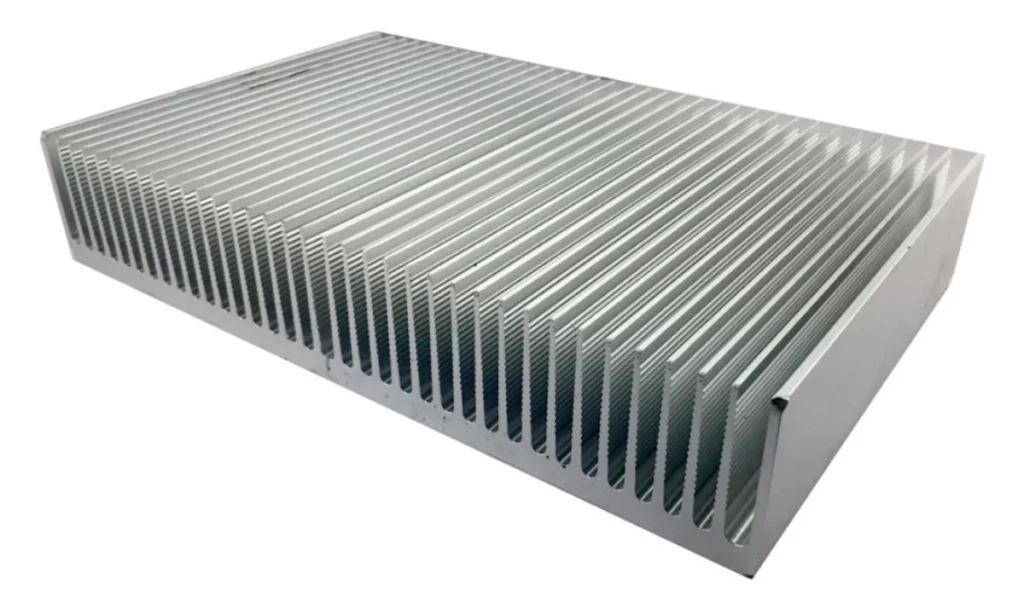
To assist thermal engineers and sourcing specialists in evaluating custom tooling feasibility, the following technical summary outlines industry-standard specifications, tolerances, and mechanical benchmarks associated with custom aluminum heat sink profiles.
+-----------------------------------------------------------------------+
|             HEAT SINK PROFILE SPECIFICATION REFERENCE                 |
+--------------------+--------------------------------------------------+
| Parameter          | Industry Benchmark / Technical Specification     |
+--------------------+--------------------------------------------------+
| Preferred Alloys   | 6063-T5 / 6063-T6 / 6061-T6 Aluminum             |
| Thermal Conduct.   | 201 W/m·K (6063-T5) | 166 W/m·K (6061-T6)          |
| Standard Aspect    | Up to 10:1 (Standard) | Up to 20:1 (Advanced)     |
| Surface Treatment  | Black Anodizing / Clear Anodizing / Chromate     |
| Surface Emissivity | Raw: ~0.05 | Anodized: 0.85 - 0.90               |
| Machining Precision| CNC Fly-Cutting Flatness within ±0.02 mm         |
+--------------------+--------------------------------------------------+
By specifying optimal alloys like 6063-T5, configuring fin arrays for expected airflow conditions, and incorporating secondary CNC machining directly into the procurement workflow, engineers and buyers can develop highly reliable, cost-effective aluminum heat sink profiles tailored to demanding thermal management applications.