Adresse
304 Nord Kardinal
St. Dorchester Center, MA 02124
Arbeitszeiten
Montag bis Freitag: 7AM - 7PM
Am Wochenende: 10AM - 5PM
Adresse
304 Nord Kardinal
St. Dorchester Center, MA 02124
Arbeitszeiten
Montag bis Freitag: 7AM - 7PM
Am Wochenende: 10AM - 5PM
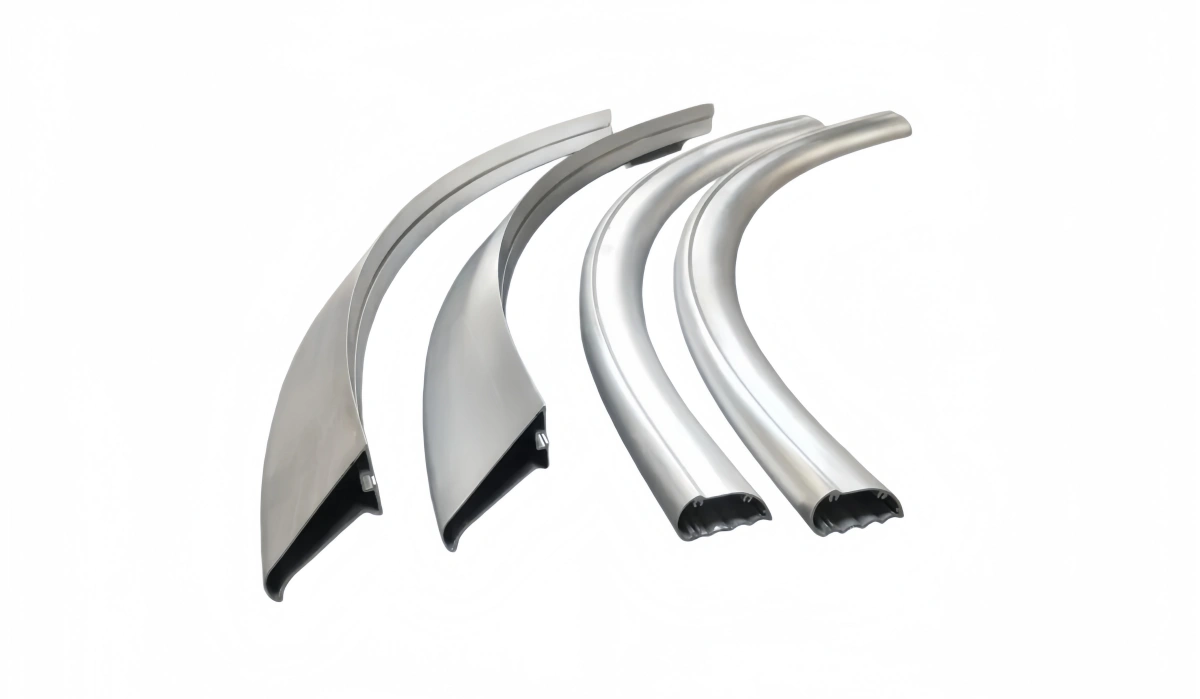
In the high-stakes world of industrial manufacturing, the demand for lightweight, high-strength, and complex curved components has never been greater. Aluminum profile stretch bending has emerged as the definitive solution for creating large-scale architectural frames, aerospace ribs, and automotive structural components. This sophisticated process involves gripping an extrusion at both ends and stretching it to its yield point while simultaneously wrapping it around a fixed or moving die. Unlike traditional bending, the aluminum profile stretch bending method allows for superior control over the material’s neutral axis, significantly reducing common defects like wrinkling and collapsing. However, mastering aluminum profile stretch bending requires a profound understanding of metallurgy, mechanical physics, and precision engineering. This guide provides a comprehensive analysis of the challenges, solutions, and optimization strategies inherent in the aluminum profile stretch bending industry.
To truly understand why profile stretch bending is preferred over roll bending or press bending, one must look at the stress distribution within the material. In a standard bend, the inner radius is compressed while the outer radius is stretched, which often leads to cross-sectional distortion. However, aluminum profile stretch bending adds a significant tensile load that shifts the entire cross-section into the plastic deformation zone. By stretching the profile, we eliminate the compression zone on the inner radius, which is the primary cause of buckling. The success of an profile stretch bending operation depends on the precise calibration of the “stretch rate”—usually between 1% and 3%—which ensures the material reaches its plastic state without entering the “necking” phase where it begins to fail. Throughout the profile stretch bending cycle, the machine must maintain a constant tension, even as the profile wraps around the die, requiring advanced hydraulic or servo-controlled feedback loops. This mechanical synergy is what allows aluminum profile stretch bending to produce parts with extremely tight tolerances and high structural integrity, making it indispensable for modern high-speed rail and aerospace applications where even a millimeter of deviation can lead to assembly failure.
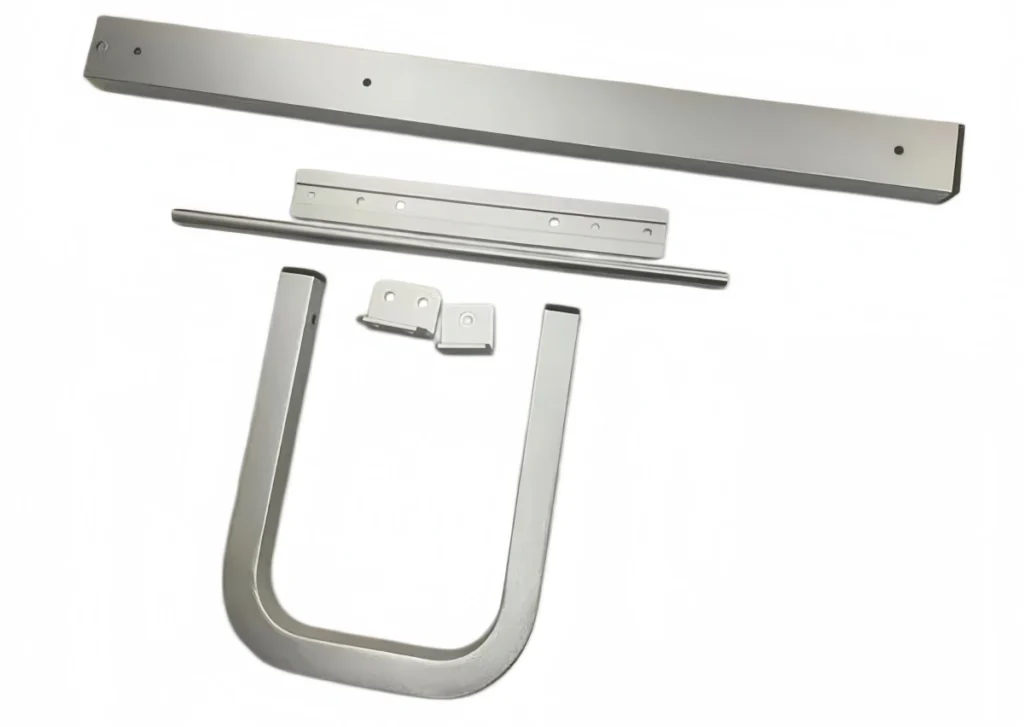
Contour deviation is perhaps the most frequent obstacle encountered during aluminum profile stretch bending. This issue arises from “springback,” the elastic recovery that occurs when the tensile force is released and the profile attempts to return to its original shape. In the context of aluminum profile stretch bending, springback is not a uniform value; it varies based on the alloy grade, the temper (such as T5 or T6), and even the humidity or temperature of the production environment. When performing stretch bending on large-radius curves, the ratio of elastic-to-plastic deformation is higher, meaning the springback effect is more pronounced. To counter this, engineers must utilize “over-bending” techniques, where the die is designed with a smaller radius than the final desired part. Advanced stretch bending software now allows for Finite Element Analysis (FEA) to predict this recovery, but real-world variables—like the slight metallurgical differences between extrusion batches—often require manual intervention. Precision in stretch bending is achieved when the operator can measure the deviation of the first “test piece” and adjust the machine’s wrap angle or tension parameters to compensate for the specific resistance of that material batch. Without this rigorous attention to detail, aluminum profile stretch bending projects can suffer from high scrap rates and inconsistent part-to-part quality.
Maintaining the aesthetic and structural surface quality is a primary goal in profile stretch bending. The most common surface issues include cracking, “orange peel” textures, and depressions. Cracking typically occurs on the outermost surface of the bend where the tensile stress is at its maximum; if the profile stretch bending machine applies too much force, or if the material lacks sufficient elongation properties, the grain structure will pull apart. “Orange peel” is a micro-surface deformation caused by large grain sizes in the aluminum alloy, which becomes visible during the aluminum profile stretch bending process as the material is stretched. Furthermore, surface depressions often plague hollow profiles where the wall thickness is insufficient to resist the radial pressure of the die. To mitigate these risks, the selection of lubricants is vital. High-performance lubricants reduce the friction between the aluminum and the die, preventing “galling” or scratching. In high-end aluminum profile stretch bending, engineers often use Nylon or PTFE-coated dies to protect the finish of architectural-grade extrusions. By balancing the tensile load and the friction interface, aluminum profile stretch bending can produce mirror-finish components that require no secondary polishing, significantly reducing the total cost of production and enhancing the visual appeal of the final product.
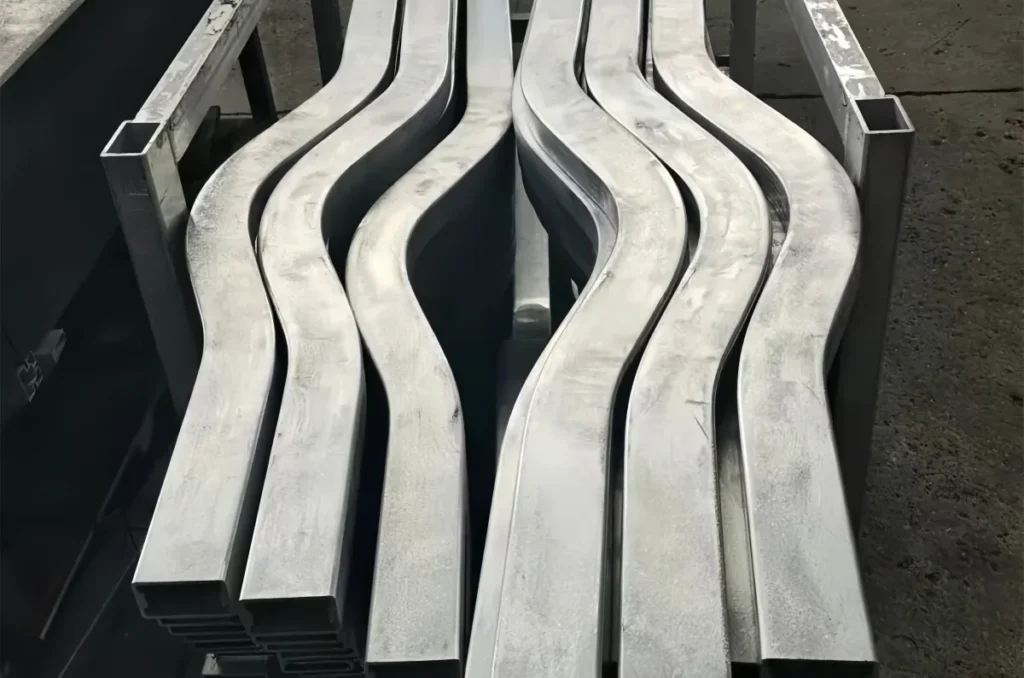
Asymmetrical profiles present a unique nightmare for aluminum profile stretch bending operators. Because the center of gravity and the shear center of the profile do not coincide, the application of linear tension causes a torsional moment, leading the profile to “twist” during the bend. This twisting is a natural physical reaction during profile stretch bending when one side of the profile has more mass or a different geometry than the other. Verticality errors—where the profile tilts away from the intended plane—are similarly caused by unbalanced stresses. To solve these issues in profile stretch bending, manufacturers must employ “differential tensioning” or specialized clamping jigs that can apply corrective torque during the bending cycle. Modern CNC profile stretch bending machines are equipped with multi-axis grippers that can rotate slightly to counteract the predicted twist. Additionally, the use of “side pressure” rollers can help keep the profile pinned against the die, preventing it from wandering or tilting. Mastering the stretch bending of complex, asymmetrical shapes is what separates world-class fabricators from standard workshops, as it requires a deep understanding of the moment of inertia and the secondary stresses that arise when metal is forced into non-linear geometries.
The die is the heart of the profile stretch bending operation. A common misconception is that the die should be an exact replica of the CAD drawing. In reality, a successful profile stretch bending die must be a “corrected” version of the part. This involves complex compensation for springback, where the die profile is mathematically “tightened.” Furthermore, for profiles that exhibit significant cross-sectional collapse, the die must incorporate “cavity compensation” to support the outer walls. During the stretch bending setup phase, it is common to perform “trial and error” runs, but sophisticated shops now use 3D scanning to compare the test part to the master template. If the aluminum profile stretch bending results show a consistent deviation, the die is re-machined or shimmed. Another innovative solution in aluminum profile stretch bending is the use of modular dies with adjustable segments. These segments can be moved via hydraulic actuators to change the radius in real-time, allowing one tool to produce a variety of curves or to adjust for different material tempers on the fly. This level of die sophistication ensures that the aluminum profile stretch bending process remains repeatable and accurate over thousands of production cycles, even when material variables fluctuate.

Hollow aluminum extrusions are notoriously difficult to bend without them collapsing or buckling. In the profile stretch bending industry, internal supports—or fillers—are the primary defense against this structural failure. For simple shapes, high-density polyethylene (HDPE) or flexible nylon mandrels are inserted into the cavity before the profile stretch bending begins. For more complex internal geometries, “flexible steel snakes” or articulated mandrels are used, which provide rigid support against the radial force while remaining flexible enough to follow the curve. In some high-precision profile stretch bending applications, the cavity is filled with a low-melting-point alloy or even pressurized hydraulic fluid to ensure that every millimeter of the wall is supported from the inside. This is particularly crucial in aluminum profile stretch bending for aerospace ducting, where the internal flow diameter must remain constant. The choice of filler significantly impacts the cycle time of aluminum profile stretch bending, as the filler must be inserted, the bend completed, and the filler removed. Therefore, optimizing the “loading and unloading” of fillers is a key focus for manufacturers looking to improve the throughput of their aluminum profile stretch bending production lines while maintaining zero-defect quality standards.
One of the most significant costs in aluminum profile stretch bending is the “process” or the extra material required for the machine’s grippers to hold the profile. Because the ends held by the grippers are subjected to extreme localized stress and deformation, they must be trimmed off after the aluminum profile stretch bending process is complete. In many cases, this can result in 10% to 20% material waste. To improve the economic sustainability of aluminum profile stretch bending, engineers work to minimize this “effective length.” This can be achieved by designing dies that allow the grippers to get closer to the start of the bend radius. Some advanced aluminum profile stretch bending machines use “contour-matching jaws” that grip the profile’s specific shape more efficiently, requiring less surface area to maintain a secure hold. Furthermore, by carefully calculating the arc length and the transition zones, aluminum profile stretch bending specialists can reduce the raw material margin, which, over a large production run of architectural panels or automotive frames, can save hundreds of thousands of dollars in aluminum costs. Material efficiency is a core pillar of lean manufacturing within the aluminum profile stretch bending sector, directly impacting both the environmental footprint and the competitive pricing of the finished components.
The metallurgical state of the aluminum extrusion is a decisive factor in the success of aluminum profile stretch bending. Most industrial profiles are made from 6000-series alloys, but their “temper” or heat-treatment state changes their behavior under tension. T4 aluminum is solution heat-treated and naturally aged, making it relatively soft and highly ductile—perfect for the most challenging profile stretch bending geometries. However, T4 lacks the final strength required for most structural applications. T6 aluminum, which is artificially aged, is much stronger but has lower elongation, making it prone to cracking during profile stretch bending. A common industry work-around is to perform the aluminum profile stretch bending while the material is in the T4 state and then “age” the finished parts in an oven to reach the T6 state. This ensures the material is easy to form but ends up with maximum strength. However, this adds a secondary processing step. Alternatively, some manufacturers use “warm profile stretch bending,” where the profile or the die is heated to increase the material’s ductility. Understanding the interaction between heat treatment and mechanical deformation is essential for any engineer involved in profile stretch bending, as the wrong temper selection can lead to either a part that is too weak or a part that breaks during the bending cycle.
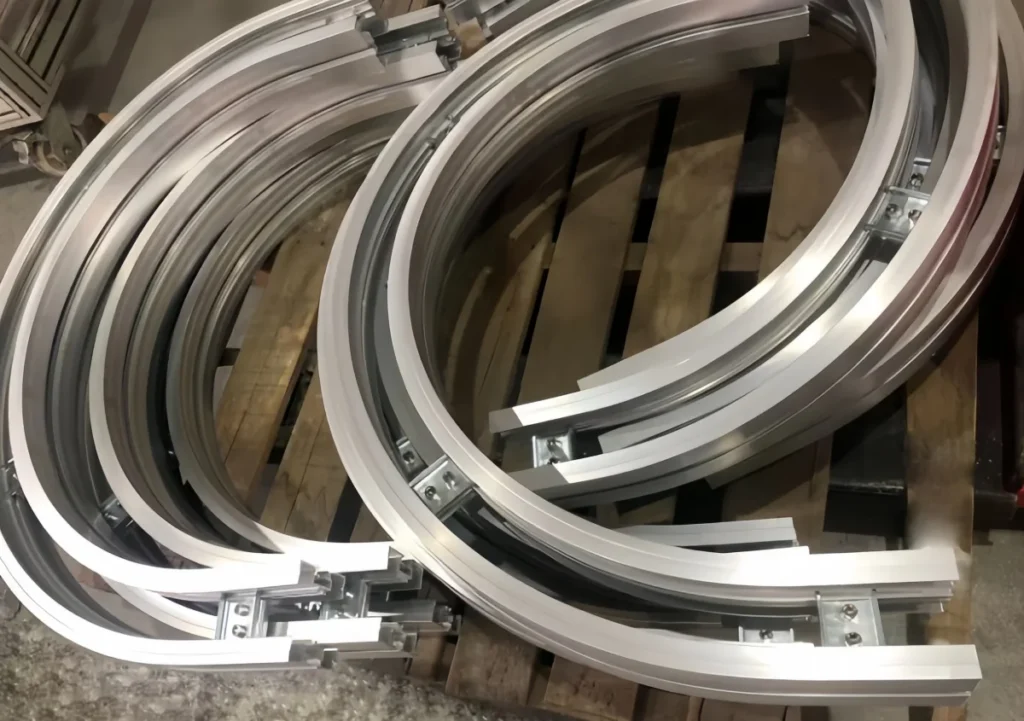
Safety is the most critical operational concern in any aluminum profile stretch bending facility. The process involves storing a massive amount of potential energy within the tensioned aluminum profile. If a profile has a hidden defect—such as an extrusion seam or a large inclusion—it can snap without warning during the aluminum profile stretch bending cycle. A “snap-back” event can release the profile at high speeds, potentially causing fatal injuries or destroying expensive machinery. Therefore, modern aluminum profile stretch bending stations must be enclosed within safety cages made of high-impact polycarbonate or steel mesh. Operators must follow strict protocols, ensuring they are never in the “snap zone” while the machine is under load. Furthermore, the aluminum profile stretch bending equipment should be fitted with emergency stop sensors that can detect a sudden drop in hydraulic pressure (indicating a break) and instantly freeze the machine’s movement. Regular non-destructive testing (NDT) of the gripper jaws and the hydraulic cylinders is also mandatory to prevent mechanical failure. By prioritizing safety through both physical barriers and rigorous technical training, aluminum profile stretch bending companies can protect their most valuable asset—their workforce—while maintaining the high-tension precision required for world-class manufacturing.
The evolution of aluminum profile stretch bending has transformed how we design and build our modern world. From the soaring curves of iconic stadiums to the structural skeletons of electric vehicles, aluminum profile stretch bending provides the unique capability to combine lightweight materials with complex, high-strength geometries. As we have explored, the process is a delicate balance of managing springback, preventing surface defects, and ensuring metallurgical integrity. By embracing advanced CNC technology, optimizing material usage, and maintaining the highest safety standards, manufacturers can overcome the “difficult and winding” path of aluminum profile stretch bending. As Industry 4.0 continues to integrate with metal fabrication, the future of aluminum profile stretch bending lies in real-time data monitoring and AI-driven predictive modeling, ensuring that every bend is as perfect as the digital design that inspired it. For any professional in the field, mastering the art and science of aluminum profile stretch bending remains a vital cornerstone of industrial excellence.